 Author: Eiji OKUBO Sales Network: Amazon.com / Amazon.co.jp   |
Author: Eiji OKUBO Sales Network: Amazon.com / Amazon.co.jp |
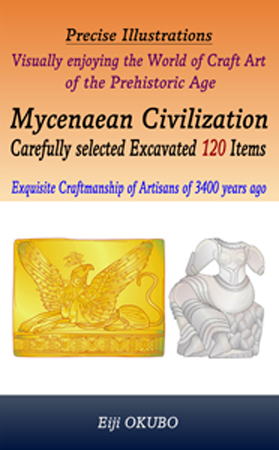
| Written by Eiji Okubo, Printed books and e-books Heritage of Minoan and Mycenaean civilizations Detailed data on Ruins and Excavated items |
| Visually enjoying the World of Craft Art, Mycenaean Civilization Excavated 120 Items |
 |
| subtitle: Data and explanations of excavated items language: English format: e-book / Web-download to Amazon-kindle, PC, e-book-reader, tablet-device, mobile-phone size: 197pages (kindle screen) / capacity: 267Mb sales: Amazon Network / Amazon.com / Amazon.co.uk |
| Sumary: This e-book is written in English, a "Precise Illustrations and Data Book" of excavated items from the ruins of the prehistoric Mycenaean civilization, and is also a visual "Introductory Book" to the search for the Mycenaean civilization. This e-book selects 120 of the most outstanding artifacts from the main items excavated from important ruins of the Mycenaean civilization, which flourished on the Greek mainland from around 1600 to 1200 BC, and provides commentary focusing on the exquisite craftsmanship produced by skilled Mycenaean workshop artisans. All carefully selected artifacts are illustrated by the author, along with basic information such as the site where they were excavated, the age and period of their creation, characteristics, size, and the museum where they are exhibited and their accession/inventory numbers. This e-book will invite you into the "World of Craft Art" of the Mycenaean civilization through the particularly important excavated items carefully selected from among the artifacts exhibited in archaeological museums across Greece, including the National Archaeological Museum of Athens, as well as museums in the Peloponnese and Central Greece. Contents: I What is the Mycenaean Civilization? II Gold Products III Silver Products IV Semi-precious stones and Faience Jewelry V Bronze Sword and Dagger VI Pottery VII Worship Statue VIII Fresco IX Stone Seal X Stone Products XI Linear B Clay Tablet XII Ivory Products XIII Bronze daily necessities |
| Sample Page:(excerpt) ---------- In the third millennium BC, the “Neolithic Age” ended and the “Bronze Age” began in the Mediterranean region. Archaeologists refer to the Bronze Age in mainland Greece as the “Helladic Age,” from the Greece own name Hellas. The Age consists of three main sub-phases: EH-MH-LH periods. The Late Helladic period, the final period of the Bronze Age, is called the “Mycenaean Civilization,” after the Mycenae of Argolis region, where the civilization flourished most, and where region is situated in the eastern part of the Peloponnese peninsula. The Mycenaean Era includes the Middle Helladic period of the late 17th century BC. In particular, the Mycenaean Civilization developed rapidly after 1600 BC in the Late Helladic LHI period, when the burial of the royal families and relatives took place in the Grave Circle A/GCA on the lower slope of the Citadel in the Mycenae Palace. Also, Grave Circle B, a circular cemetery, which was built to the west of GCA where a surprisingly large amount of gold and silver treasures was excavated, was built around the end of the 17th century BC, slightly earlier than GCA. This circular cemetery GCB was used, same as GCA, for the burial of the royal family and high-ranking members of the Mycenae Palace. 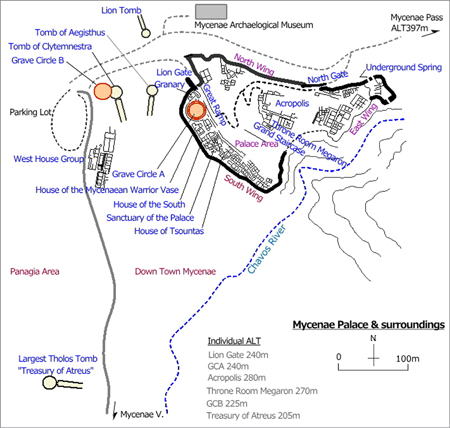 Site: Major Sites, Mycenae Palace and surroundings Local: Argolis, Peloponnese Drawing: Eiji OKUBO 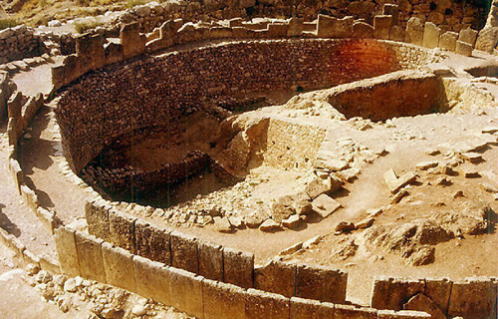 Site: Grave Circle A, Mycenae Palace Situation: A unique Mycenaean cemetery a) double slab circle=outer diameter 27.5m, inner 25m b) center left tomb=largest Shaft Grave IV c) center right tomb=Shaft Grave I Era: MHIII-LHI, 1625-1500 BC Local: Argolis, Peloponnese / 11km north-northeast from Argos city Photo: 1982 GPS: 37°43'49.50''N 22°45'23''E / ALT 240m II-01 Gold Goblet 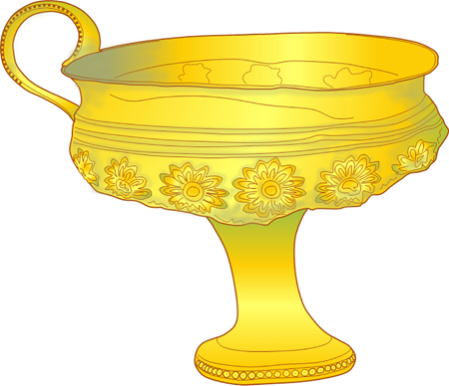 Site: Shaft Grave IV, GCA, Mycenae Palace Shape & Decoration: Gold Goblet with ring-handle rosettes in repoussé, granulation technique Era: LHI, ca. 1550 Museum: NAM, inv. No. 351 Local: Argolis, Peloponnese / 11km north-northwest from Argos city 90km west-southwest from Athen Drawing: Eiji OKUBO II-02 Gold Cup 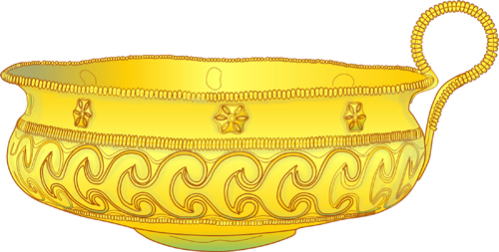 Site: Chamber Tomb 10, Dendra Shape & Decoration: Gold Cup, ivy & rosette patterns, granulation technique Era: LHIIIA1, 1400-1375 BC Museum: NAM, inv. No. 8743 mouth diameter D130mm, H50mm excluding handle Local: Argolis, Peloponnese / 7km north-northeast from Tiryns Palace Drawing: Eiji OKUBO GPS: 37°39’24’’N 22°49’32’’E / ALT 60m II-03 Vaphio style Gold Cup, "Bull hunting" 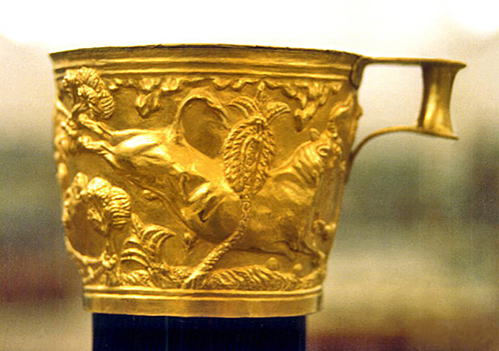 Site: Royal Tholos Tomb, Vaphio Shape & Decoration: Gold Cup in Vaphio style rampaging bulls & young man trying to catch in repoussé Era: LHIIA, 1500-1450 BC Museum: NAM, inv. No. 1758 / mouth diameter D108mm Local: Laconia, Peloponnese Photo: 1982 The two gold cups were made around 1500 BC, during the middle of the New Palace Era of the prosperous Minoan civilization, the Late Minoan LMIB period, which corresponds to the Early Mycenaean civilization and the Late Helladic LHIIA period on the Greek mainland. What can be emphasized is that the two gold cups are not works of Mycenaean civilization, but are undoubtedly works that were imported by boat from the Minoan civilization on the island of Crete, 200km southeast, and there is almost 100% probability that this is the case. And based on the design of the cups and the expression of the hammering process, there is no reason to deny that they are clearly metalworks of the highest level from the peak of the Minoan civilization, the "New Palace Era with dancing flowers." II-09 Gold Signet Ring, “Treasure of the Mycenaean Acropolis” 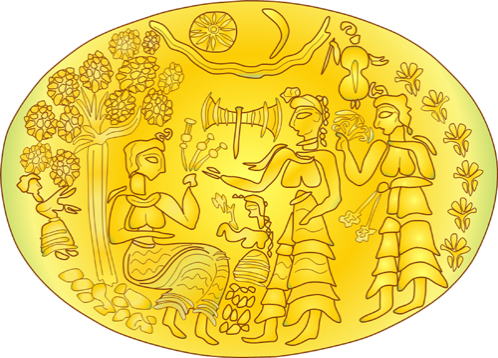 Site: House of the Great Ramp, Citadel, Mycenae Palace Shape & Decoration: Gold Signet Ring, “Golden Treasure of Acropolis Mycenae” Epiphany: six goddesses, double axe, shrine with sacred tree, Sun and crescent moon, flowers Era: LHIIA, 1500-1450 BC Museum: NAM, inv. No. 992 / L34mm, W25mm Local: Argolis, Peloponnese Drawing: Eiji OKUBO II-14 Gold Signet Ring, “Griffin” motif 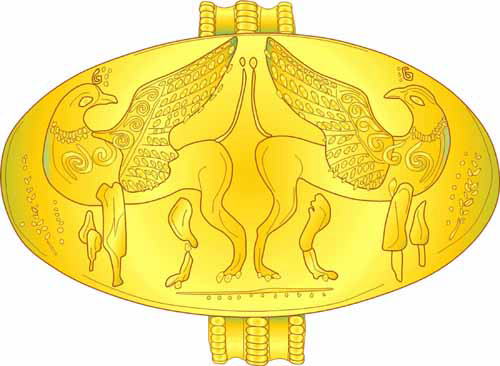 Site: Chamber Tomb 68, Lower Town, Mycenae Shape & Decoration: Gold Signet Ring, two griffins arm (hoop)=granulation technique Era: LHII-LHIIIA1, 1500-1375 BC Museum: NAM, inv. No. 2970 / L30mm Local: Argolis, Peloponnese / 11km north-northeast from Argos city Drawing: Eiji OKUBO II-15 Gold Beads type Seal, “Griffin” motif 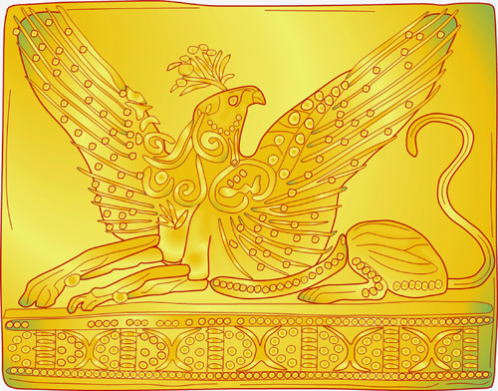 Site: Royal Tholos Tomb IV, Nestor’s Palace Shape & Decoration: Gold Seal, cushion shape a griffin spreading wings, triglyph pattern back side=diamond (mesh) pattern Era: MHIII-LHIIA, 1650-1450 BC Museum: NAM, inv. No. 7986 / L27mm, W21mm, T6mm Local: Messenia, Peloponnese 13km north from Pylos port / 35km west from Kalamata city Drawing: Eiji OKUBO II-17 Gold Death Mask, known as “Gold mask of Agamemnon” 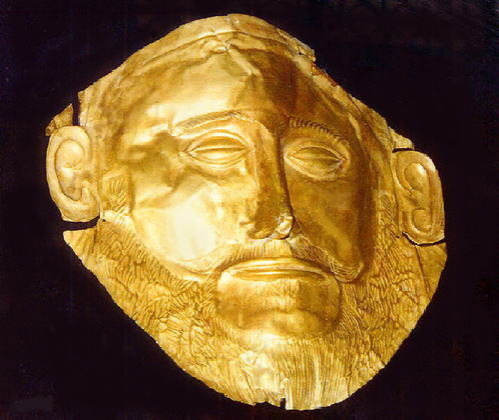 Site: Shaft Grave V, GCA, Mycenae Palace Shape & Decoration: Gold death mask, in repoussé Excavator J.H. Schliemann's conjecture: “Gold mask of Agamemnon,” 13th century BC scholar's judgment: Death-mask of a "King" over 300 years older than King Agamemnon Era: LHI, ca. 1550 BC Museum: NAM, inv. No. 624 / H250mm, weight 168.5g Local: Argolis, Peloponnese Photo: 1987 Six Shaft Graves in Grave Circle A were used for the burial of the royal family and relatives in the Mycenae Palace for about 100 years, beginning of the Mycenaean Era, the Middle Helladic MHIII period to Late Helladic LHI period, 1625 to 1500 BC. Among the graves, the bodies of three men, who were determined to have been cremated within the grave, were found in the medium-sized Shaft Grave V at the northwest side in the stone slab circle. German businessman J.H. Schliemann discovered two gold death masks which covered the faces of the deceased in the Shaft Grave V, where amazing gold and silver products were unearthed. One of the masks, 250mm high and 168.5g in weight, is a beautiful gold mask that probably accurately depicts the face of the buried king, it reminds us of that the king was a fearless and gentle person. Regarding this gold mask, Schliemann, who was an excavator but not an archeological researcher, chanted that beautifully crafted gold mask in repoussé was the "Gold mask of Agamemnon" by based on Greek mythology, which he had believed in since childhood (it was later revealed that he did not know Greek mythology as a child). II-21 Gold Diadem (full size) 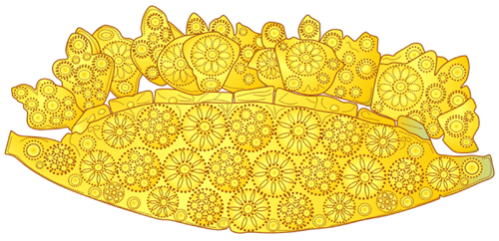 Site: Shaft Grave III, GCA, Mycenae Palace Shape & Decoration: Full size Gold luxurious Diadem rosette, circle, stippling patterns in repoussé Era: LHI, 1550-1500 BC Museum: NAM, inv. No. 1 / L635mm Local: Argolis, Peloponnese Drawing: Eiji OKUBO 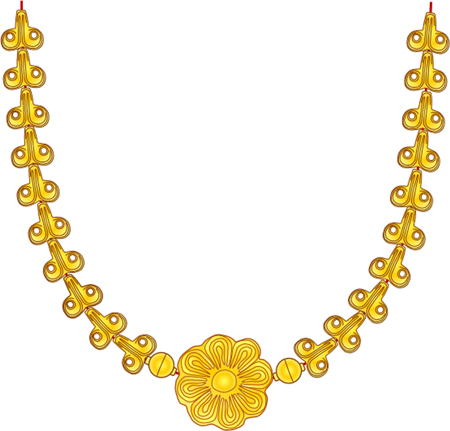 Site: Chamber Tomb 41, Heraion (old name Prosymna) Shape & Decoration: Gold beads Necklace, rosette, lily flower and small sphere shaped Era: LHIIIA, 1400-1300 BC Museum: NAM, inv. No. 0834 Local: Argolis, Peloponnese / 4km south-southeast from Mycenae Palace Drawing: Eiji OKUBO GPS: 37°41’45’’N 22°46’21’’E / ALT 130m II-33 Gold embossed products: "circle, diamond, meandering bands" motifs 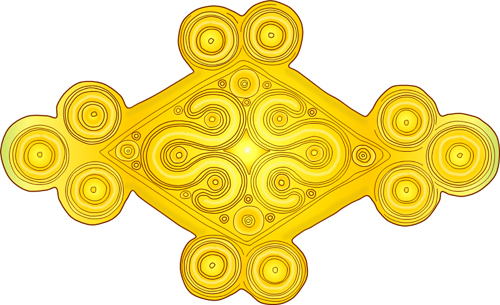 Site: Shaft Grave IV ans V, GCA, Mycenae Palace Shape & Decoration: Gold embossed ornaments circular pattern, rhombus, meandering line Era: LHI, ca. 1550 BC Museum: NAM, inv. No. 669 / L76mm excavated total of 18 items Local: Argolis, Peloponnese / 11km north-northeast from Argos city Drawing: Eiji OKUBO GPS: 37°43’49.50’’N 22°45’23’’E / ALT 240m III-02 Gold-mounted Silver Goblet, “Fern leaves” motif 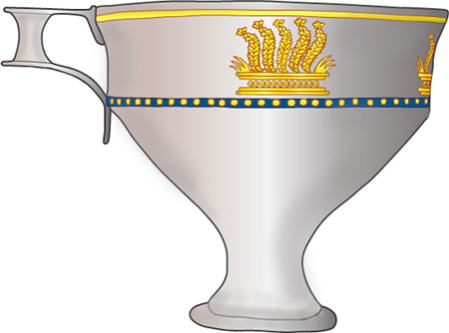 Site: Shaft Grave IV, GCA, Mycenae Palace Shape & Decoration: Silver Goblet, elaborate fine inlay technique fern leaves (or flower baskets), horizontal gold line, stippling gold on niello line Era: LHI, ca. 1550 BC Museum: NAM, No. 390 / H155mm Local: Argolis, Peloponnese Drawing: Eiji OKUBO IV-01 Amber Beads Necklace 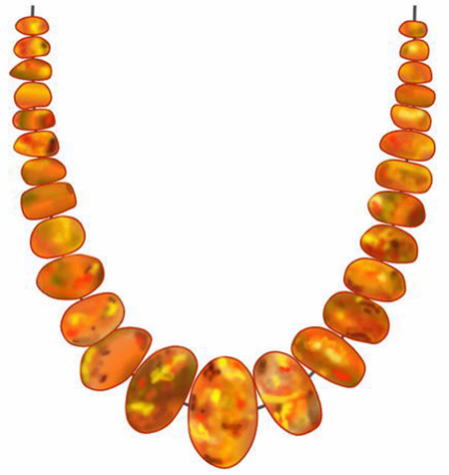 Site: Shaft Grave III, GCA, Mycenae Palace Shape & Decoration: Amber bead Necklace Era: LHI, 1550-1500 BC Museum: NAM Local: Argolis, Peloponnese Drawing: Eiji OKUBO IV-03 Glass paste Beads Necklace 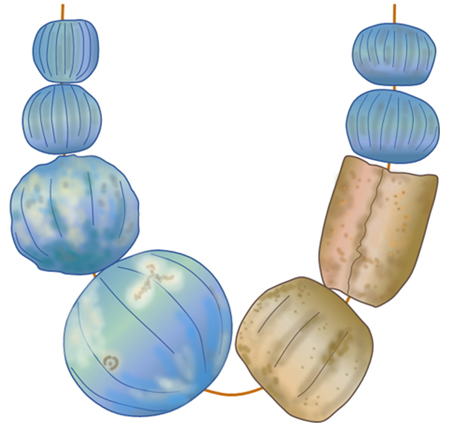 Site: Chamber Tomb 517, Kalkani, Mycenae Shape & Decoration: Glass paste bead Necklace Era: LHII-LHIIIA, 1500-1300 BC Museum: NAM, inv. No. 1724 Local: Argolis, Peloponnese / 11km north-northeast from Argos city Drawing: Eiji OKUBO V-07 Decorated Bronze Dagger, Inlaid Blade 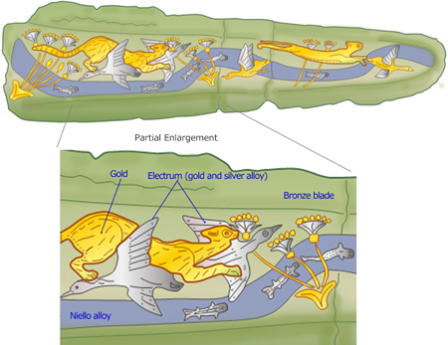 Site: Shaft Grave V, GCA, Mycenae Palace Shape & Decoration: Bronze Dagger of the “Tangles type” inlaid decoration of gold, niello, electrum alloy: two lions (or leopards) attacking waterfowl, fish swimming in the river Era: LHI, ca. 1550 BC Museum: NAM, inv. No. 765 / L165mm Local: Argolis, Peloponnese Drawing: Eiji OKUBO VI-02 Pictorial style Stemmed Krater vessel 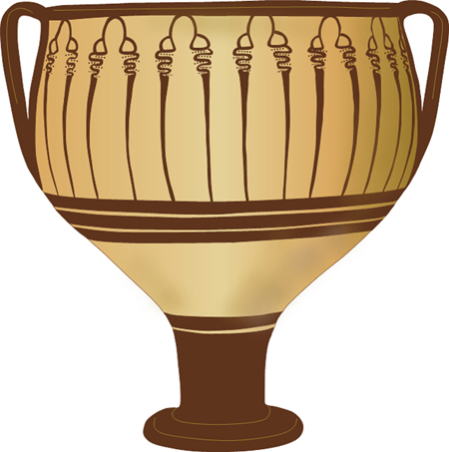 Site: Citadel, Mycenae Palace Shape & Decoration: Pictorial style, Krater with leg, whorl-shell pattern Era: LHIIIB1, 1300-1250 BC Museum: NAM, inv. No. 1148 / H370mm Local: Argolis, Peloponnese Drawing: Eiji OKUBO Related: Megaron Complex, Mycenae Palace 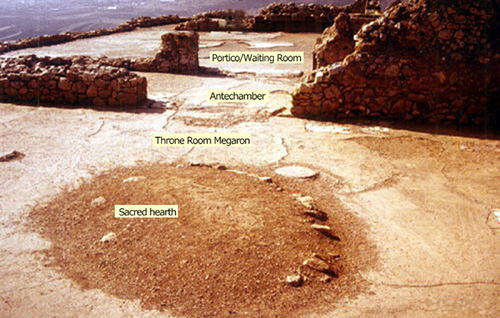 Site: Throne Room and surroundings, Mycenae Palace Situation: Megaron Complex=Three-room contiguous structure a) distant=Portico/Waiting Room b) middle=Antechamber c) front=Throne Room with Sacred hearth surrounded by four columns Era: built=MHIII, ca 1600 BC or slightly later collapse=LHIIIB2, ca 1200 BC or slightly later Local: Argolis, Peloponnese Photo: 1982 VIII-01 Fresco, “Minoan Goddess with Sheaves of Grain” 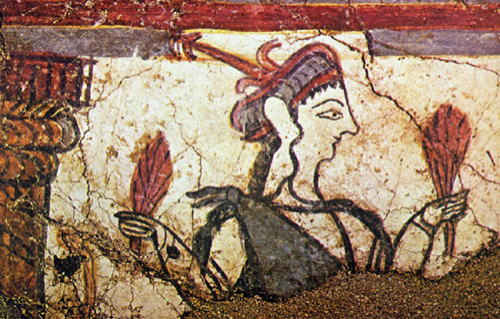 Site: Room of the Fresco, Royal Sanctuary, Mycenae Palace Shape & Decoration: Fresco “Minoan Goddess with sheaves of grain” Era: LHIIIB, ca. 1250 BC Museum: NFAM / right index finger to left index finger: about 26cm Local: Argolis, Peloponnese Photo: 1982 IX-02 Amethyst Seal  Site: Tholos Tomb, Koukounara Shape & Decoration: cushion-shaped, Amethyst Seal, soldiers fighting with swords Era: LHI-LHIIIA, 1550-1300 BC Museum: PLAM, inv. No. 13 / L17mm Local: Messenia, Peloponnese / 8km southeast from Nestor’s Palace Drawing: Eiji OKUBO GPS: 36°58'08.50''N 21°45'39''E / ALT 215m X-01 Gold decorated Minoan style Alabaster vase 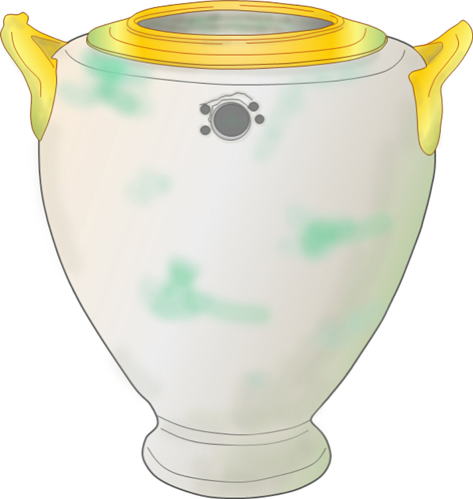 Site: Shaft Grave V, GCA, Mycenae Palace Shape & Decoration: Made in Egypt, Minoan style Alabaster vase gold coving the mouth and handles Era: LHI, ca. 1550 BC Museum: NAM, inv. No. 829 / H170mm Local: Argolis, Peloponnese Drawing: Eiji OKUBO XII-01 Ivory Statue, “Noble Mycenaean Woman” 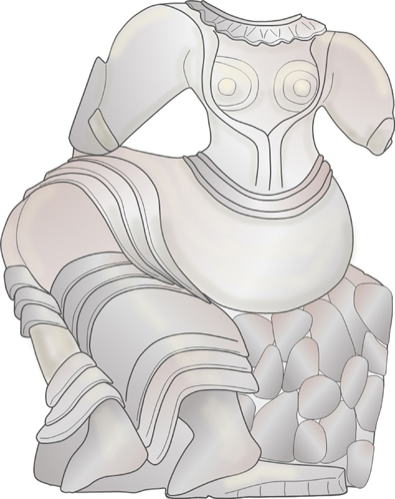 Site: Citadel, Mycenae Palace Shape & Decoration: Ivory Statue of Female or Goddess, sitting quietly on a rock Era: LHII-LHIIIA, 1500-1300 BC Museum: NAM, inv. No. 5897 / H85mm Local: Argolis, Peloponnese Drawing: Eiji OKUBO ----------  |