 Author: Eiji OKUBO Sales Network: Amazon.com / Amazon.co.jp   |
Author: Eiji OKUBO Sales Network: Amazon.com / Amazon.co.jp |
| Written by Eiji OKUBO, Printed books and e-books Heritage of Minoan and Mycenaean civilizations Detailed data on Ruins and Excavated items |
| The Minoan Palace of Knossos (v. 2) |
 |
| subtitle: Touring to the Minoan Sites and Prehistoric Arts language: English format: Paperback printing paper: Non-glossy high-quality paper printing ink: High-saturation premium ink size: 8in.x10in. (203mm x 254mm) 509 pages sales: Amazon Network / Amazon.com / Amazon.co.uk |
| Summary: This book is 8in. x 10in. (203mm x 254mm) version, 509 pages, an explanatory book on the Prehistoric Minoan civilization. It provides a thorough and detailed explanation of the Knossos Palace ruins on Crete, the largest center of the Minoan civilization. The book provides a detailed explanation of all the ruins in the Knossos Palace, including many of unpublished interior photos of the palace, which are currently the restricted area for tourists, and drawings of the ruins. At the same time, the book is including the Precise illustrations of most of the important artifacts excavated in the palace and related ruins, and many photographs. The excavated items are selected from the countless exhibits at the Heraklion Archaeological Museum, which boasts one of the largest displays of Minoan civilization artifacts, as well as at other museums on the island of Crete, and at the National Archaeological Museum of Athens on the Greek mainland. By exploring and comparing artistic motifs, trends, genealogy, and so on in the coordinated manner, the Minoan civilization, known as the "Europe's first civilization," the book will be elucidated in a comprehensive, three-dimensional, and easy-to-understand manner. Book structure: The book consists of volumes 1 and 2, both were published simultaneously. Volume 1 I Overview of Minoan Civilization & Knossos Palace II Around Palace, West Court, South Wing I II Central Court & Throne Room Complex IV Palace Royal Sanctuary in West Wing V West Storerooms & Linear B Clay Tablet VI Fresco “Goddess Parisienne” Volume 2 VII King’s Room Complex & Shrine of Double Axe VIII Queen’s Room Complex IX Fresco “Bull leaping” X North Wing & East Wing, Fresco “Ladies in Blue” XI Prehistoric Sites around Knossos Palace |
| Sample Page:(excerpt) ---------- VII-3-02 Minoan King's Room, known as "Double Axe Room" 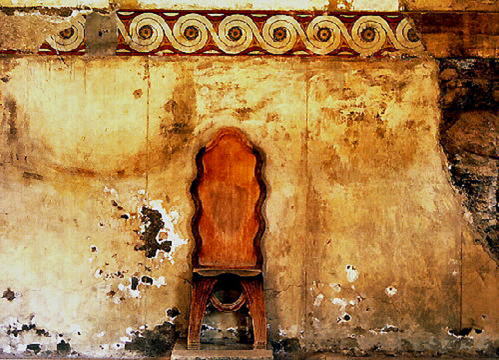 Site: Double Axe Room (King’s Living Room), East Wing, Knossos Palace (Currently Restricted Area) a) Minoan Fresco of running spiral pattern on New Palace Era wall b) wall & fresco=preservation of state during excavation c) wooden Throne (replica) Era: MMIIIA-LMIIIA1, 1625-1375 BC Local: Central North, Crete Photo: 1982 The most important room in the King's Room Complex, so-called the "Double Axe Room" by researchers, is the King's Living Room, decorated with relatively subdued frescoes and with the floor paved with gypsum slabs. The Double Axe Room has no walls between it and the adjacent rooms, and is arranged in the "Three-room Contiguous Structure" style, separated only by thick corner columns. It is a comfortable structure suited to the natural environment of the Mediterranean island of Crete, with maximum consideration given to the circulation of light and air. In the King's Room Complex, the floors of all the rooms are paved with brightly colored gypsum stones, and the walls, as in the Double Axe Room, are beautifully finished with white gypsum plaster and frescoes. Unlike the strict atmosphere of the Throne Room (the king's official room), which is one of the "Three most important elements" in the West Wing and is the central spot of "Politics and Administration," the Double Axe Room in the East Wing gives the impression of a world of peace and openness where one can spend time quietly. 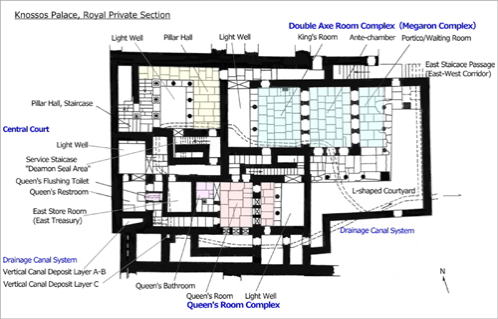 Site: Royal Family’s Private section, East Wing, Knossos Palace a) Plan for 1st floor b) upper left=Pillar Hall c) upper right=King’s Room Complex, Three-room contiguous structure d) lower left=Queen’s Room Complex, Three-room contiguous structure, and Bathroom e) left end=Queen’s Restroom with Flushing Toilet Era: MMIIIA-LMIIIA1, 1625-1375 BC Local: Central North, Crete Drawing: Eiji OKUBO 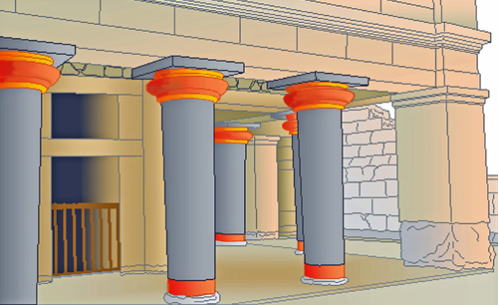 Site: King’s Room Complex, East Wing, Knossos Palace (Currently Restricted Area) 90% parts of entire structure, except for foundations, restored to concrete a) left wooden frame=Antechamber b) inside of columns=Portico/Waiting Room No tour rope regulations for tourists in 1980s Era: MMIIIA-LMIIIA1, 1625-1375 BC Local: Central North, Crete Drawing: Eiji OKUBO Related: Mycenaean "Megaron Complex style" palace architecture The most important room in Mycenaean palace architecture is the ruler's room, or Throne Room. In terms of the layout of the surrounding area, first there is the Portico/Waiting Room, a space with an entrance and porch, with an open exit surrounded by columns, followed by the Antechamber, and finally the King's Room/Throne Room, arranged in succession at the very back. This layout of the "Three-room contiguous structure" is called the "Mycenaean Megaron Complex style." The Megaron Complex architectural style of the Mycenaean civilization on mainland Greece is said to have been developed by the Mycenaeans around 1400 BC, inspired by the "Three-room contiguous structure" architectural style of the Minoan palaces. And it is estimated that the construction of the Mycenaean "Sacred Hearth" began even later, in the latter half of the Mycenaean civilization, during the LHIIIB1 period, between 1300 and 1250 BC. Related: Acropolis – Throne Room Megaron Complex 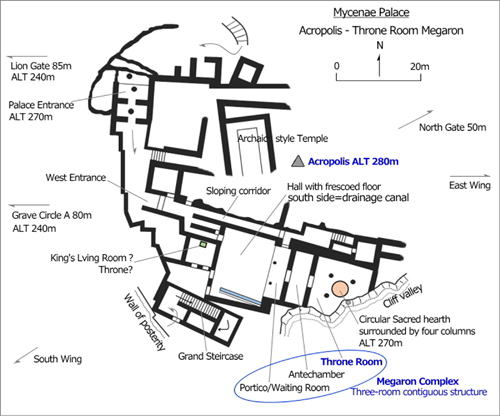 Site: Plan of Citadel, Mycenae Palace Situation: Acropolis – Throne Room “Megaron Complex” Era: built=MHIII, ca 1600 BC or slightly later collapse=LHIIIB2, ca 1200 BC or slightly later Local: Argolis, Peloponnese Drawing: Eiji OKUBO 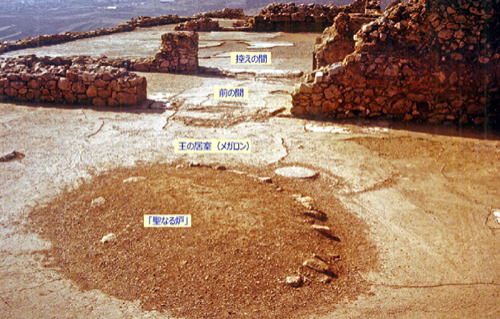 Site: Throne Room and surroundings, Mycenae Palace Situation: Megaron Complex=Three-room contiguous structure a) distant=Portico/Waiting Room b) middle=Antechamber c) front=Throne Room with Sacred hearth surrounded by four columns Era: built=MHIII, ca 1600 BC or slightly later collapse=LHIIIB2, ca 1200 BC or slightly later Local: Argolis, Peloponnese Photo: 1982 VII-4-01 Pillar Hall with vermilion columns & light-well structure 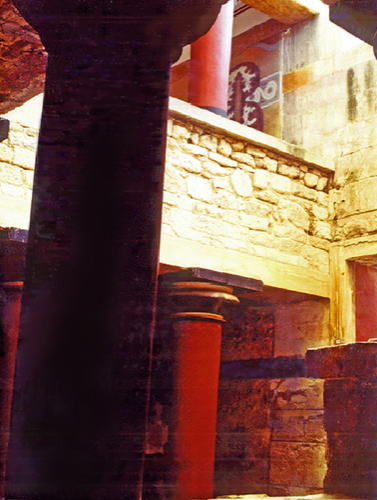 Site: Pillar Hall, East Wing, Knossos Palace (1st floor=Currently Restricted Area) a) looking up from gypsum stone paved first to second floors b) 2nd floor=Fresco sacred “8”-shaped Shield pattern c) restoration by Evans (1900), except for floor, foundations, stone stairs Era: MMIIIA-LMIIIA1, 1625-1375 BC Local: Central North, Crete Photo: 1982 In the East Wing of the Knossos Palace, adjacent to the west side of the Royal Family's Private section, there is a very beautiful section called the Pillar Hall, which is made up of vermilion columns and stairs and has the light-well structure. The Pillar Hall is by no means the large room or space, but although structurally it is very complex, it is an architecturally stable and harmonious section. Minoan engineers likely designed the New Palace at Knossos on the site of the Old Palace, which was destroyed in the strong earthquake around 3,650 years ago, toward the end of the MMIIB period of the Middle Minoan civilization. After much deliberation, not only in terms of the structural mechanics unique to stone-built structures, but also in terms of aesthetic spatial presentation, this section of the New Palace is so impressive, and it can be said that the Pillar Hall was one of the sections of the New Palace that they put the most effort into building around 1625 BC. VII-4-02 Veranda style Room, 2nd floor of Pillar Hall The walls of the Veranda style Room on the second floor of the Pillar Hall, a beautiful section in the light-wall structure next to the west of the Royal Family's Private section, were decorated with frescoes featuring the horizontal band of spiral line patterns and the sacred "8"-shaped large shields resembling the open bivalve. This spiral line pattern is a high-quality wall decoration that could be said to be one of the standard decorations in noble rooms in the Minoan palace, including the King's Room and Queen's Room. Currently, the original Minoan fresco fragments are on display at the Heraklion Archaeological Museum HAM. On the other hand, the fresco replica with the spiral line pattern and "8"-shaped large shields has been painted using modern chemical paints on the south wall of the restored Veranda style Room on the second floor of the East Wing for tourists to see. 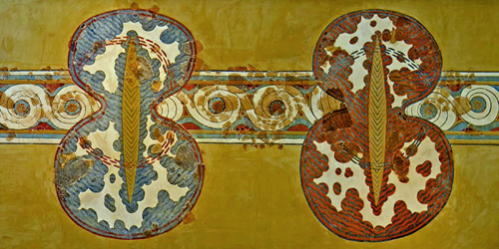 Site: Veranda style Room, East Wing, Knossos Palace Shape & Decoration: Fresco, typical Minoan motifs, “8”-shaped shields and running spiral line patterns Era: MMIIIA-LMIIIA1, 1625-1375 BC Museum: HAM Local: Central North, Crete Photo: 1996 VII-5-02 Northern Section of Shrine of Double Axe The northern section of the Shrine of Double Axe which was the Minoan royal sanctuary, does not occupy a large area and can be described as a collection of relatively small rooms, including several narrow passages paved with stone slabs. Evans' excavation confirmed three narrow rooms and spaces in the northern section, two narrow, short passages running east-west, the North Passage and South Passage, and a short North-South Passage located inside the section on the west side of the sanctuary, parallel to the ascending general passage to the Central Court. Five spouted pithos jars, large and small, were excavated from the room that Evans called the “Magazine of Spouted Pithoi,” on the east side of the short North-South Passage. Currently, the entire royal sanctuary area is off-limits, but in the northern section, if you go west through one (the south side Passage), of the two very narrow and short East-West Passages, which can be accessed from the paved room running north-south on the east side, you will come to a narrow space about 50cm wide and 2.5m deep. According to Evans' excavation report, this narrow space contained about 15 pieces of pottery stacked on top of each other, including wide-mouthed jars, candlestands, and small vases. The candlestand is a simply shaped: as a shallow dish with a cylindrical candle holder resembling an egg-stand in the center. Among the jars excavated, ten of them are almost identical in shape, and can be described as either a giant tumbler or a simple flower vase, and 20 to 30cm tall, slightly conical towards the base, but with a modest cylindrical shape each excluding the handles. These vessels were originally colored black or dark gray, and had designs of blooming white lilies on them, which is why researchers call them "Lily Vases." 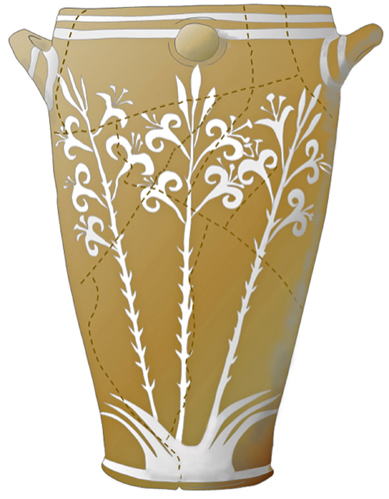 Site: Shrine of Double Axe, Southeast Wing, Knossos Palace Shape & Decoration: on dark color background Era: MMIIIB-LMIA, ca. 1550 BC Museum: HAM, inv. No. 2619 / H265mm Local: Central North, Crete Drawing: Eiji OKUBO VIII-2-01 Lovely fresco decoration of Queen's Room The Queen's Room with its gypsum stone floor seems a little narrow in terms of space, but there is the two-column Room of Veranda type on the east side, and small courtyards opening to the sky on the east and south sides for lighting, so it is easy to imagine that the bright light of Crete always entered the back of the room. Like many other sections of the Knossos Palace, the walls and columns of the Queen's Room were decorated with beautiful frescoes: including adorable dolphins and countless swimming fish, which are marine designs that are the greatest characteristic of the Minoan civilization, and also spiral lines, abstract patterns, and the "Dancing Minoan Woman." 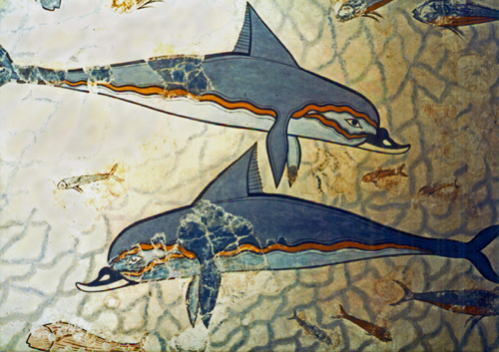 Site: Queen’s Room, East Wing, Knossos Palace Shape & Decoration: Fresco “Dolphins and Fish” on hanging/upper wall of north side Era: MMIIIA-LMIB, 1625-1450 BC Museum: HAM restoration by Piet Christiaan de Jong Local: Central North, Crete Photo: 1994 X-1-05 North Gate & North Pillar Hall A raised stone walkway extends eastward from the Royal Road and Theater Area, heading toward the North Gate building in the North Wing. The eastern door of the narrow North Gate on the first floor of the building leads to the North Pillar Hall, a large room located to the east of it. Approximately 12m east to west and 22m north to south, the North Pillar Hall is a magnificent structure with two large columns and two rows of eight square pillars supporting the ceiling, making it one of the most magnificent and imposing sections of the Palace of Knossos. 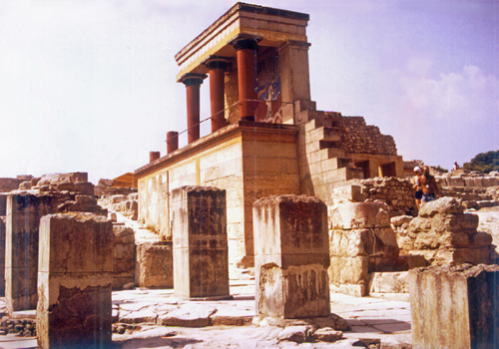 Site: North Gate-Northern Passageway, North Wing, Knossos Palace a) North Gate Building= concrete restoration by Sir Arthur John Evans b) Pillars on the left= North Pillar Hall / some scholars call the “Customs Office” Era: New Palace Era, MMIIIA-LMIIIA1, 1625-1375 BC Great fire & Palace collapse in ca. 1375 BC Local: Central North, Crete Photo: 1982 X-3-02 Fresco “Leadies in Bule” Excavator Sir Arthur John Evans called the "Loom Weight Basement," where the ground floor area just north of the East Staircase Passage in the East Wing of the Knossos Palace ruins. One of the treasures of the Heraklion Archaeological Museum HAM, the fresco "Ladies in Blue," was found in this area near the north passage of the East Storerooms. Long curly hair with gorgeous hair accessories, thin eyebrows, dignified yet gentle faces, gorgeous necklaces and bracelets that were in fashion and imported directly from Alexandria, Egypt, excessively large breasts, and costume with novel design of Minoan weaving... Researchers have described the Palace of Knossos as the "Palace of beautiful frescoes," and this "Ladies in Blue" is undoubtedly the most captivating Minoan fresco, providing the first answer to that association. This beautiful fresco, dating back to 1650 to 1500 BC, during the early "New Palace Era with dancing Flowers," collapsed down from a noble room on the upper floor, probably third floor, of the East Wing during the final collapse of the Knossos Palace, which was caused by the great fire around 1375 BC. 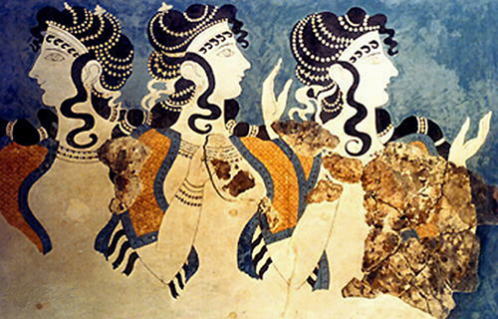 Site: Loom Weight Basement, East Wing, Knossos Palace Shape & Decoration: Fresco “Ladies in Blue” three noble ladies of Knossos Palace, blue background Era: MMIIIA-LMIA, 1625-1500 BC Museum: HAM / Restoration by Swiss archaeological artist Émile Gilliéron Local: Central North, Crete Photo: 1994 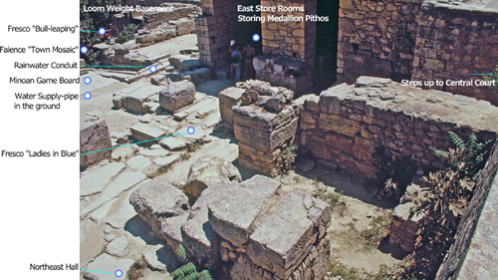 Site: Loom Weight Basement, East Wing, Knossos Palace Situation: Excavation spots of many important items: a) Fresco “Ladies in Blue” and “Bull leaping” b) Faience “Town Mosaic” and Minoan “Royal Game Board” c) Stone rainwater conduit, Water supply-pipe d) many Storing pithoi Era: New Palace Era and Old Palace Era a) mainly remains: New Palace Era, MMIIIA-LMIIIA1, 1625-1375 BC b) partially remains: Old Palace Era, MMIB-LMIIIA1, 1900-1625 BC Local: Central North, Crete Photo: 1982 A large number of valuable excavated items representing the crafts of the Minoan civilization were discovered from remains of the East Wing of the Knossos Palace, known as the "Loom Weight Basement." These items had fallen from the noble halls and rooms on the upper floor XI-4-02 Chamber Tomb 1 & Tomb 1a The Chamber Tomb 1 of the Royal Tomb at Isopata site, which has the long Dromos/Passage stretching more than 55m in the northward direction, and the sides of the burial Chamber room and the Fore room were perfectly constructed with exquisite masonry of cut stones and had the sturdy design. 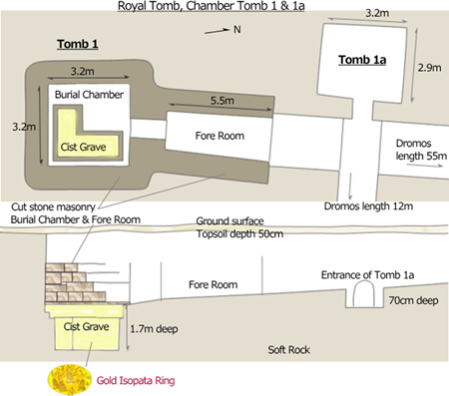 Site: Royal Tomb, Chamber Tomb 1 & 1a, Isopata Situation: Structural drawing, “Gold Isopata Ring” from cist grave in Chamber room Re. information: Papers, Sir Arthur John Evans “Archeology of other regions v. LXV” (1913) Era: LMII, 1450-1400 BC Local: Central North, Crete / 2.8km north from Knossos Palace Drawing: Eiji OKUBO GPS: 35°19'17''N 25°09'19''E / ALT 90m A cist grave approximately 1.7m deep was excavated in an L-shaped on the southeast floor of the square burial chamber, and a magnificent gold signet ring was unearthed from inside, depicting a scene of four Minoan women dancing while being watched by a goddess and two snakes. This is one of the greatest masterpieces of jewelry in Minoan craft art. The four women are wearing thick, Minoan-style skirts; the two on the left and the woman in the center are younger women as they have hair ornaments and swaying long hair, while the woman on the right has her hair tied up and is therefore probably a slightly older woman than the three. As violets are blooming all around the four, it is likely spring, and the location is the grassland such as Gypsades Hill south of the Palace of Knossos. The owner (death) of this gold signet ring was a Minoan queen, a beautiful princess, or a high-ranking aristocrat who lived in the Knossos Palace during the Minoan civilization's most peaceful and prosperous period. It is believed to have been made during the heyday of the “New Palace Era with dancing Flowers,” during the Late Minoan civilization LMIA to LMIB period, 1550 to 1450 BC. 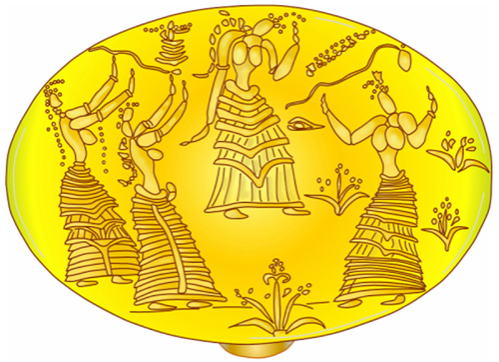 Site: Royal Tomb, Chamber Tomb 1, Isopata Shape & Decoration: Gold Signet Ring, oval-shaped seal face Epiphany: Goddess, two snakes, four dancing women, meadow with violets blooming Era: LMI, 1550-1450 BC Museum: HAM, inv. No. 424 / L26mm Local: Central North, Crete Drawing: Eiji OKUBO ----------  |