 Author: Eiji OKUBO Sales Network: Amazon.com / Amazon.co.jp   |
Author: Eiji OKUBO Sales Network: Amazon.com / Amazon.co.jp |
| Written by Eiji Okubo, Printed books and e-books Heritage of Minoan and Mycenaean civilizations Detailed data on Ruins and Excavated items |
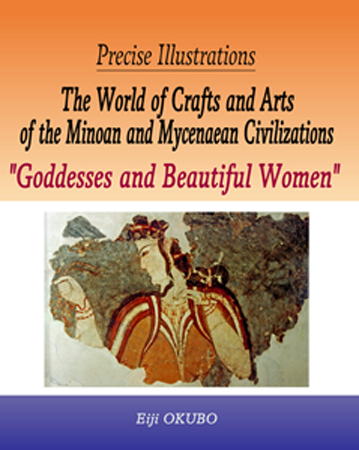
| The World of Crafts and Arts of the Minoan & Mycenaean Civilizations "Godesses and Beautiful Women" |
 |
| subtitle: Data and explanations of excavated items language: English format: Paperback printing paper: Non-glossy high-quality paper printing ink: High-saturation premium ink size: 8in.x10in. (203mm x 254mm) 340 pages sales: Amazon Network / Amazon.com / Amazon.co.uk |
| Sumary: This book is written in English, a 8 in. x 10 in. version (203 x254mm), 340 pages, a "Precise Illustrations & Data Book" of excavated items from the prehistoric Minoan and Mycenaean civilizations in the Aegean Sea. This book contains the most outstanding artifacts depicting the motif of "Goddesses and beautiful Women" from major important Minoan and Mycenaean prehistoric sites: including the Knossos Palace ruins and other Minoan sites on Crete, as well as the Mycenae Palace ruins and other Mycenaean sites on the Greek mainland. This book contains a total of 260 items, most of which are drawn using Precise Illustrations: including 150 excellent artifacts with the motif of "Goddesses and beautiful Women," and 110 illustrations and photographs of ruins and related artifacts. This book will invite you to the "World of Crafts and Arts" of the Minoan and Mycenaean civilizations through carefully selected important works among the excavated items on display at the Heraklion Archaeological Museum in Crete, the National Archaeological Museum of Athens, and other archaeological museums throughout in Greece. Content: I What are the “Minoan civilization” and “Mycenaean civilization”? II Frescoes “Goddesses and Women” III Gold Signet Rings “Goddesses and Women” and “Glamorous Jewelry” for women IV Goddesses and Female Statues and Figurines V Stone Seals and Clay Imprints “Goddesses and Women” |
| Sample Page:(excerpt) ---------- II-4-01 Minoan Fresco “Goddess Parisienne” 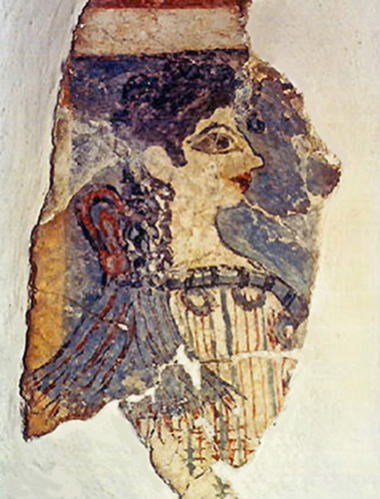 Site: West Storeroom 12, West Wing, Knossos Palace Shape & Decoration: Fresco, “La Parisienne” so-called “Goddess Parisienne” Era: LMI, ca. 1500 BC Museum: HAM, inv. No. 11 / H250mm Local: Central North, Crete Photo: 1994 One of the fresco fragments found near Room 12 of the West Storerooms, which were used under the palace administration, on the first floor of the West Wing of the Knossos Palace ruins, was named "Goddess Parisienne" by the excavator Sir Arthur John Evans. When the Knossos Palace finally collapsed around 1375 BC, the wall of the sacred Northwest Sanctuary Hall on the upper (second) floor, where the fresco was painted, was destroyed by fire, and fell into the West Storerooms below along with a large amount of rubble from the building materials. II-4-05 Mycenaean Fresco: “Minoan Goddess” 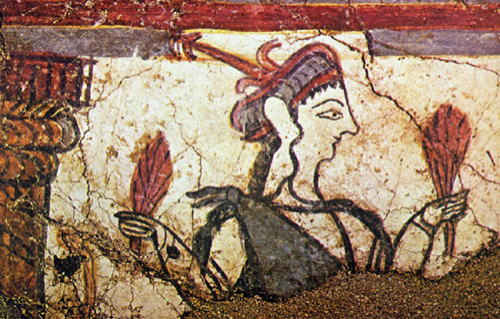 Site: Room of the Fresco, Royal Sanctuary, Mycenae Palace Shape & Decoration: Fresco “Minoan Goddess with sheaves of grain” Era: LHIIIB, ca. 1250 BC Museum: NFAM / right index finger to left index finger: about 26cm Local: Argolis, Peloponnese Photo: 1982 A small Minoan goddess is depicted in the lower left corner of the Fresco of "Three Minoan Goddesses," which adorned the Room of the Fresco in the Sanctuary of the palace area of the Mycenae Palace ruins. 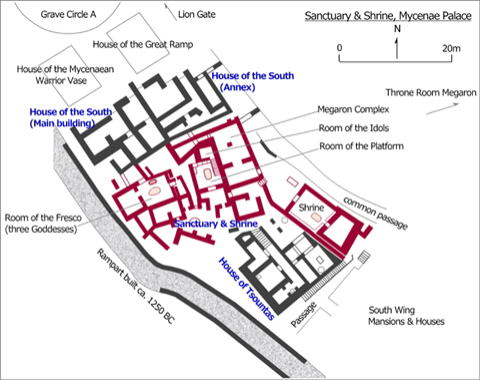 Site: Plan of Royal Sanctuary & Shrine, Mycenae Palace a) House of the Great Ramp b) House of the Mycenaean Warrior Vase c) House of the South, Main Building and Annex d) Royal Sanctuary and Shrine e) House of Tsountas Era: Sanctuary construction: LHIIIB2, ca. 1250 BC Local: Argolis, Peloponnese Drawing: Eiji OKUBO II-4-08 Minoan Fresco “Ladies in Blue” 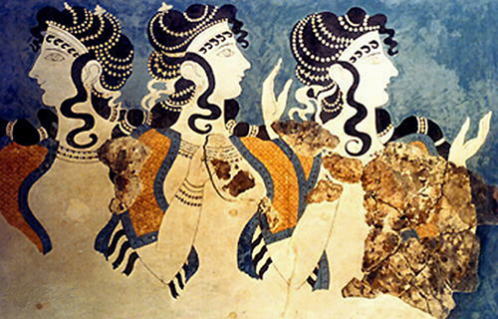 Site: Loom Weight Basement, East Wing, Knossos Palace Shape & Decoration: Fresco “Ladies in Blue,” three noble ladies of Knossos Palace, blue background Era: MMIIIA-LMIA, 1625-1500 BC Museum: HAM restoration by Swiss archaeological artist Émile Gilliéron Local: Central North, Crete Photo: 1994 Creating a gorgeous atmosphere: with long and curly hair adorned with elegant hair ornaments, thin eyebrows, and dignified yet clean faces, trendy luxurious necklaces and bracelets which directly imported from Alexandria of Egypt where an advanced country, overly large busts, and innovatively designed Minoan woven costumes sewn for the first time in history - - - The noble women of Knossos Palace who behaving elegantly against a blue background reminiscent of the Aegean Sea. A large number of valuable excavated items representing the crafts of the Minoan civilization were discovered from remains of the East Wing of the Knossos Palace, known as the "Loom Weight Basement." These items had fallen from the noble halls and rooms on the upper floor during a great fire around 1375 BC when the Knossos Palace finally collapsed. And Sir Arthur John Evans' excavations uncovered several terracotta warp weights for weaving luxury textiles for noble women in this section. II-4-09 Minoan Fresco: “Princess and Minoan Youth” 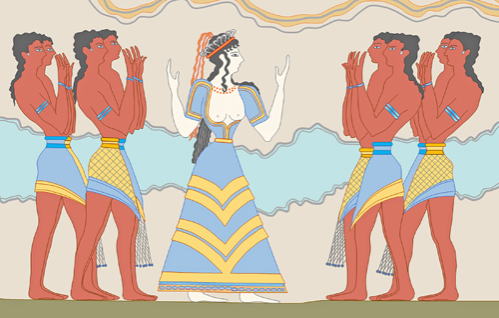 Site: Corridor of Procession Fresco, Southwest Wing, Knossos Palace Shape & Decoration: Fresco “Princess and Minoan youth” of “Procession Fresco” The princess wears an ivory tiara and a thick, luxuriously sewn skirt with the characteristic “V”-shaped pattern of the Minoan civilization. Era: MMIIIA-LMIB, 1625-1450 BC Museum: HAM Local: Central North, Crete Drawing: Eiji OKUBO A Minoan princess with a vermilion hair ornament and an ivory tiara wears a thick, luxuriously sewn skirt with the characteristic "V" pattern of Minoan civilization. Young men, on the other hand, wear traditional loincloths and blue sapphire armlets on their arms. The princess has her palms facing her, while the men are showing respect by pointing their palms toward her. 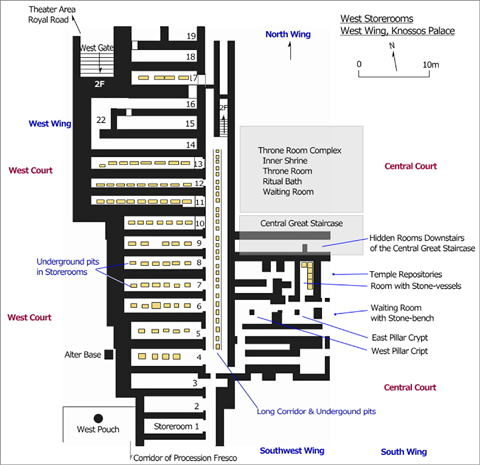 Site: Plan of West Storerooms, West Wing, Knossos Palace Era: MMIIIA-LMIIIA1, 1625-1375 BC Local: Central North, Crete Drawing: Eiji OKUBO II-4-10 Minoan Relief Fresco "Minoan Princess" 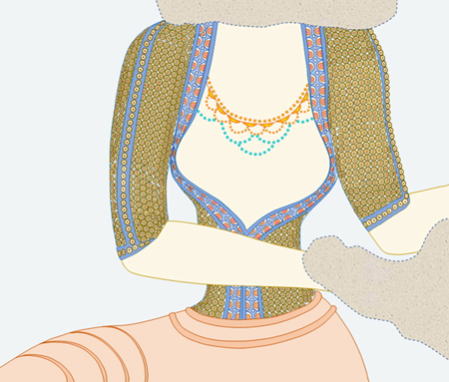 Site: Shrine, Pseira Shape & Decoration: Relief Fresco, “Minoan Princess” Era: LMIB, 1500-1450 BC Museum: HAM Local: Eastern North Coast, Crete / 13km east from Agios Nikolaos city Drawing: Eiji OKUBO GPS: 35°11'08''N 25°51'51''E / ALT 15m One fresco depicting the beautiful woman from the Minoan civilization, exuding grace and beauty, is the fresco "Minoan Princess or Goddess," found at the remains of the Shrine, the settlement on the island of Pseira on the north coast of Crete. This captivatingly elegant relief fresco depicts two women wearing unique costumes with intricate Minoan patterns was created during the heyday of the Minoan "New Palace Era with dancing Flowers," between 1500 and 1450 BC. II-4-11 Cycladic Fresco “Minoan Woman” 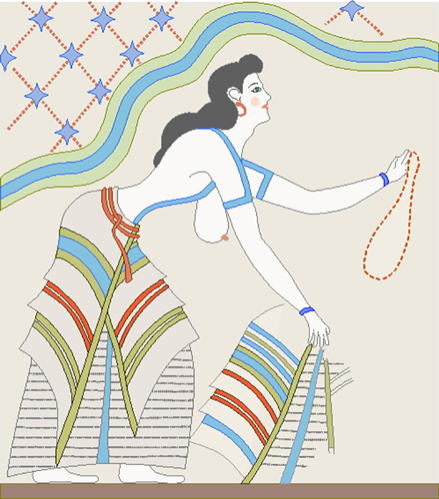 Site: North Wall, “Minoan Woman’s House,” Cycladic Settlement of Akrotiri Shape & Decoration: Fresco “Minoan Woman” scene=a woman handing over a necklace beautiful woman wearing skirt with noble design of layered stitching Era: Middle Cycladic MCII-MCIII, ca. 1650 BC Museum: THPM Local: Santorini, Aegean Sea Drawing: Eiji OKUBOブラウ GPS:36°21’06’’N 25°24’12’’E / ALT 30m II-4-13 Minoan Fresco “Dancing Minoan Woman” 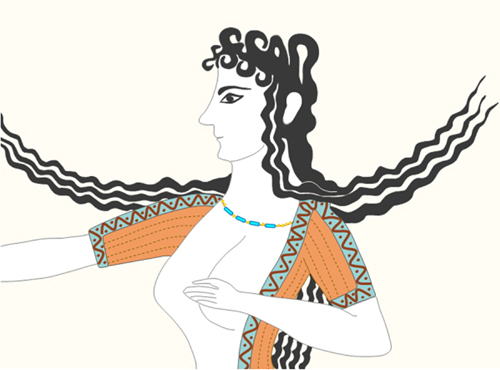 Site: Queen’s Room, East Wing, Knossos Palace Shape & Decoration: Fresco, “Dancing Minoan Woman” on pillar wall Era: LMI, ca. 1500 BC Museum: HAM / H370mm ·Restoration by Piet Christiaan de Jong Local: Central North, Crete Drawing: Eiji OKUBO II-4-15 Mycenaean Fresco “Ladies in Chariot” 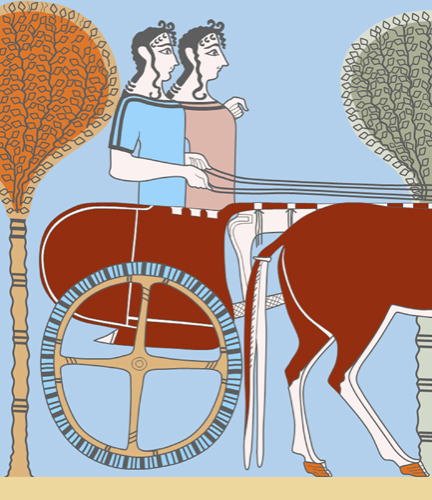 Site: King’s Room, Megaron Complex, Tiryns Palace Shape & Decoration: Fresco “Ladies in Chariot” Era: LHIIIB, 1300-1200 BC Museum: NAM, inv. No. 5882 Local: Argolis, Peloponnese Drawing: Eiji OKUBO II-4-16 Mycenaean Fresco “Mycenaean Woman holding a Pyxis” 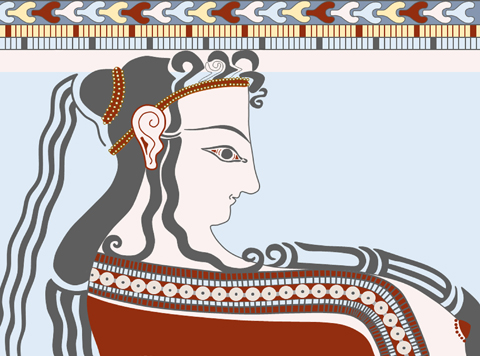 Site: Citadel, Tiryns Palace Shape & Decoration: Mycenaean Fresco, “Mycenaean Woman holding a Pyxis (Jewelry Box)” Era: LHIIIA2-LHIIIB1, ca. 1300 BC Museum: NAM, inv. No. 5883-1 Local: Argolis, Peloponnese Drawing: Eiji OKUBO The hairstyle, large breasts, and sheer clothing of the noble Mycenaean woman carrying the jewelry box are all expressions influenced by the Minoan civilization. Nearly a century has passed since the collapse of the Palace of Knossos on Crete, around 1375 BC, the largest and greatest center of the Minoan civilization. However, although the Mycenaean civilization was heavily influenced by Minoan civilization in the field of craftsmanship, its artistic heritage has continued unabated. II-4-19 Mycenaean Fresco “Noble Mycenaean Lady” 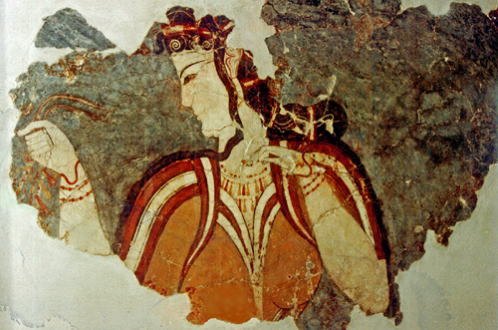 Site: Shrine, Royal Sanctuary, Mycenae Palace Shape & Decoration: Fresco “Noble Mycenaean Lady” Era: LHIIIB, ca. 1250 BC Museum: NAM, inv. No. 11670 / right thumb to left elbow: about 45cm Local: Argolis, Peloponnese Photo: 1987 Related: Mycenaean Rock-crystal Vase, one of noble Women's cosmetics 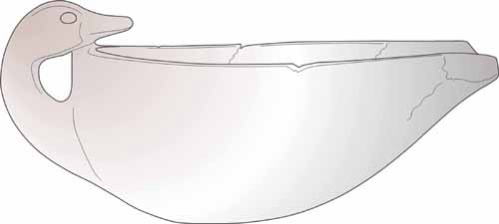 Site: Shaft Grave O, GCB, Mycenae Shape & Decoration: Rock-crystal vase, Duck shaped with spout for cosmetics imported from Minoan Crete? Era: MHIII, ca. 1600 BC Museum: NAM, inv. No. 8638, L132mm mouth height H42mm, head height H47mm Local: Argolis, Peloponnese Drawing: Eiji OKUBO III-2-02 Minoan Gold Signet Ring “Gold Ring of Archanes’ Princess” 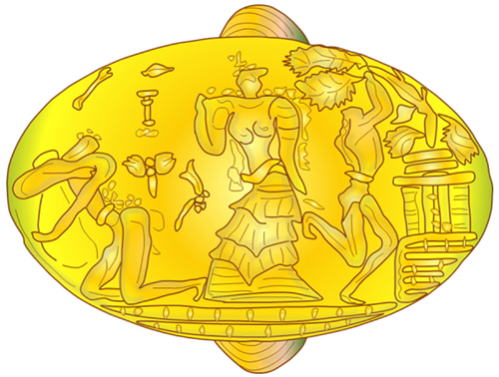 Site: Tholos Tomb A, Fourni Common Cemetery, Archanes ·so-called=”Tomb of Princess of Archanes” Shape & Decoration: Gold Signet Ring, oval-shaped seal face Epiphany: goddess, man with sacred stone “Baetylus,” man at shrine with sacred tree, butterfly Era: MMIIIB-LMIA, 1600-1500 BC Museum: HAM, inv. No. 989 / L26mm Local: Central North, Crete Drawing: Eiji OKUBO 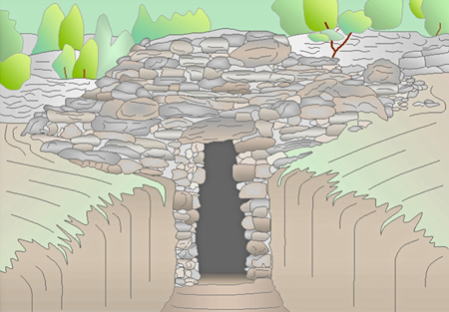 Site: Tholos Tomb A, Fourni Common Cemetery, Archanes so called “Tomb of Princess Archanes” Situation: view from Dromos length 18m to Tomb Entrance a) Tholos burial chamber inner diameter 4.5m with burial antechamber 2m square b) Tholos burial chamber floor=semi-underground type c) Tholos to Dromos=N90° (opening to East) Era: MMIIIB-LMIA, 1600-1500 BC Local: Central North, Crete / 7km south from Knossos Palace Drawing: Eiji OKUBO GPS: 35°14'42''N 25°09'32''E / ALT 430m A gold signet ring excavated from the Tholos Tomb A, believed to be the "Tomb of the Princess of Archanes" at the Archanes Fourni common cemetery, 7km south of the ruins of the Palace of Knossos, is oval in shape, 26mm wide, and a distinctive Epiphany expression. In the center of the seal stands a Minoan goddess wearing a distinctive thick skirt, and to her right is a temple-like building that appears to be a tripartite shrine with a sacred tree that curves upward, with an active young Minoan man carved into it, as if he is about to touch the branches to receive the blessings of the god. On the left side of the seal, on the other hand, there is a Minoan man kneeling at a sacred stone as if he is worshipping something, or perhaps holding a large funerary pithos, looking a little dejected. In the space between the goddess and the kneeling man there are two butterflies, and above the butterflies there are inscriptions that are thought to be from the Egyptian Pillar of Osiris, which represents the death and rebirth of plants, a view of life and death. III-2-05 Minoan Gold Signet Ring “Gold Isopata Ring” 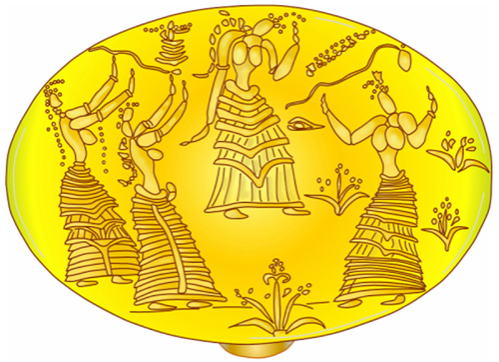 Site: Royal Tomb, Chamber Tomb 1, Isopata Shape & Decoration: Gold Signet Ring, oval-shaped seal face Epiphany: Goddess, two snakes, four dancing women, meadow with violets blooming Era: LMI, 1550-1450 BC Museum: HAM, inv. No. 424 / L26mm Local: Central North, Crete Drawing: Eiji OKUBO The Chamber Tomb 1 of the Royal Tomb at Isopata site, which has the long Dromos/Passage stretching more than 55m in the northward direction, and the sides of the burial Chamber room and the Fore room were perfectly constructed with exquisite masonry of cut stones and had the sturdy design. 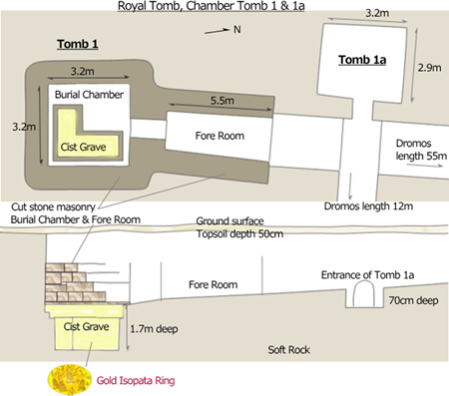 Site: Royal Tomb, Chamber Tomb 1 & 1a, Isopata Situation: Structural drawing, “Gold Isopata Ring” from cist grave in Chamber room Re. information: Papers, Sir Arthur John Evans “Archeology of other regions v. LXV” (1913) Era: LMII, 1450-1400 BC Local: Central North, Crete / 2.8km north from Knossos Palace Drawing: Eiji OKUBO GPS: 35°19'17''N 25°09'19''E / ALT 90m The scene engraved in intaglio (recessed engraving) on this oval gold signet ring, 26mm wide, is referred to by researchers as an Epiphany expression, and while it contains highly divine elements, it is also a scene that could occur in everyday life. And a small goddess and two snakes watch over the people from the heavens. The four women are wearing thick, Minoan-style skirts; the two on the left and the woman in the center are younger women as they have hair ornaments and swaying long hair, while the woman on the right has her hair tied up and is therefore probably a slightly older woman than the three. As violets are blooming all around the four, it is likely spring, and the location is the grassland such as the Gypsades Hill south of the Palace of Knossos. However, if you look closely, you will see an "eye"-like inscription near the left hip of the woman in the center. Some researchers have suggested this represents a budding sprout, but the author considers this incision to be the "Isopata's Code." Could it be that this signifies that the three young women have reached the age of conception? It is possible that the more experienced woman on the right is leading the celebration, with everyone dancing the traditional dance of joy together. If this is the case, this Epiphany expression may be a sacred scene expressing women's physiological growth and anticipation for the happy future. The owner (death) of this gold signet ring was a Minoan queen, a beautiful princess, or a high-ranking aristocrat who lived in the Knossos Palace during the Minoan civilization's most peaceful and prosperous period. It is believed to have been made during the heyday of the “New Palace Era with dancing Flowers,” during the Late Minoan civilization LMIA to LMIB period, 1550 to 1450 BC. III-2-11 Mycenaean Gold Signet Ring “Treasure of Tiryns” 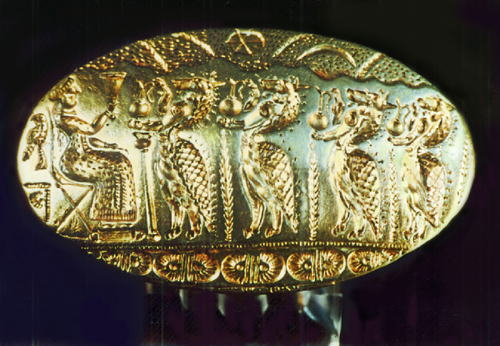 Site: Royal Tholos Tomb, Tiryns Palace Shape & Decoration: Gold Signet Ring, “Treasure of Tiryns” Epiphany: a goddess sitting on a simple stool with dove, raising a libation cup, four lion-headed, daemon/spirits offering sacred vessels, Sun and Moon in the sky, triglyph pattern in intaglio carving Era: LHII, 1500-1400 BC Museum: NAM, inv. No. 6208 ·L57mm, weight 83g, inner diameter of arm (hoop) 23-24mm Local: Argolis, Peloponnese / 15km south-southeast of Mycenae Palace Photo: 1987 GPS: 37°35’47’’N 22°48’45’’E / ALT 20m In 1915, two gold signet rings, later known as the “Treasure of Tiryns,” were discovered in a Royal Tholos Tomb. One of them, a large signet gold ring, was 57mm wide and weighed 83g. This Tiryns' large Gold Signet Ring, which boasts by far the largest size and detailed expression compared to rings excavated from ruins in various places of the Minoan and the Mycenaean civilization, is carved four legendary daemon/spirits with lion-heads and costume that looks like a thorny fruit on the right side. That is a detailed carving of a rich ritual scene in which daemon/spirits offer sacred wine in Minoan jugs to the Minoan goddess, who is seated with her back straight. An extremely large gold ring, which found in a pit grave on the floor of the Royal Tholos Tomb, is almost certainly made on the Minoan civilization on Crete, dating from the 15th century BC, judging from its size and seal processing technology. It was probably as the highest gift from Minoan Crete to the king and queen of Tiryns Palace. III-2-15 Mycenaean Gold Signet Ring “Treasure of Aidonia” 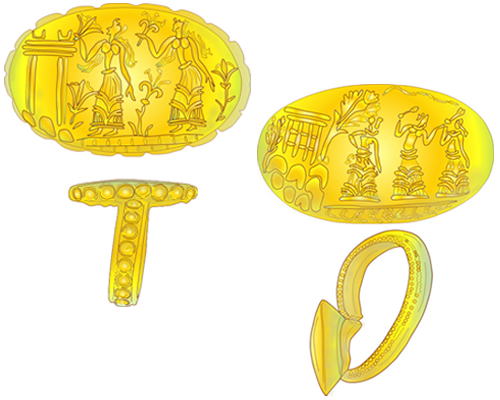 Site: Chamber Tomb 7, Common cemetery, Aidonia, near Nemea Shape &Decoration: Gold Signet Ring, “Treasure of Aidonia” Epiphany: Two goddesses walking with flowers, shrine with bull-horn U-shaped objects, papyrus and lily patterns, arm (ring part) = granulation technique and inlay technique of gemstone Era: LHII-LHIIIA, ca. 1400 BC Museum: NEAM, inv. No. 550 / L20.5mm Local: Corinthia, Peloponnese Drawing: Eiji OKUBO Site: Chamber Tomb 7, Common cemetery, Aidonia, near Nemea Shape & Decoration: Gold Signet Ring, “Treasure of Aidonia” ·arm (ring part)=granulation technique Epiphany: Three goddesses walking with flowers, shrine with sacral trees Era: LHI-LHII, ca. 1500 BC Museum: NEAM, inv. No. 549 / L25mm Local: Corinthia, Peloponnese / 20km northwest from Mycenae Palace Drawing: Eiji OKUBO GPS: 37°50’25’’N 22°34’59’’E / ALT 355m The Gold Signet Ring, excavated from the Chamber Tomb 7 in the Aidonia Common Cemetery, is engraved with a scene of three goddesses walking towards a shrine where a sacred tree grows, the decorative motif of the Minoan civilization. The two goddesses are probably holding flowers in their right hands. A thin cloud-like inscription can be seen at the top of the seal, which can be considered to represent the heaven where the gods live. It falls into the category of Epiphany expression. The side of the broken arm (hoop part) has been elaborately processed using the Minoan gold granulation technique. This suggests that the owner (death) of this gold ring, who lived in the Aidonia settlement, was a very noble woman. This gold ring may have been a gift from the royal family of the Knossos Palace around 1500 BC, during the middle of the New Palace Era, the heyday of the Minoan civilization in Crete, during the Late Minoan LMI period. A total of six gold signet rings, including some looted before the official excavation, were discovered in the Aidonia common cemetery, later to be called the "Treasure of Aidonia." The gold signet ring recovered from the Chamber Tomb 7 depicts two long-haired goddesses or noble women walking toward a sanctuary (or shrine) displaying two bull-horn U-shaped objects, each holding a papyrus and a lily in their right hand. Papyrus and lilies are also blooming abundantly around the goddesses, and the carving depicts a divine yet soothing scene in the Epiphany expression. The sides of the slightly convex gold ring's signet face, the outer perimeter of the mount, the side stones, and the outer perimeter of the arm (ring part), are decorated with fine circular frames that are likely inlaid with gemstones, glass paste, or faience. III-2-17 Mycenaean Gold Signet Ring “Goddess and Griffin” 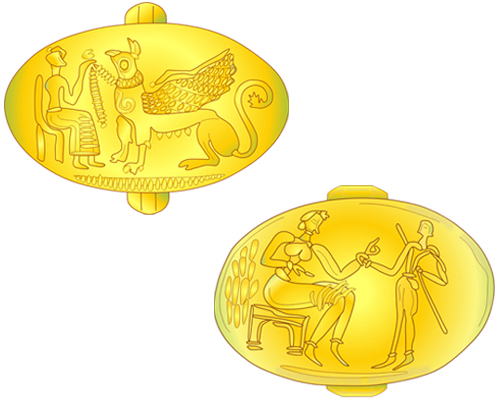 Site: Chamber Tomb 91, Panagia, Mycenae Shape & Decoration: Gold Signet Ring Epiphany: a sitting goddess, an obedient griffin with luxury leash Era: LHII-LIIIA1, ca. 1400 BC Museum: NAM, inv. 3181 / L20mm Local: Argolis, Peloponnese Drawing: Eiji OKUBO Site: Chamber Tomb 66, Lower Town, Mycenae Shape & Decoration: Gold Signet Ring Epiphany: “Sacred conversation,” Goddess sitting on a pedestal, a standing warrior Era: LHI-LHII, 1550-1400 BC Museum: NAM, inv. No. 2971 / L27mm Local: Argolis, Peloponnese Drawing: Eiji OKUBO III-2-22 Mycenaean Gold Signet Ring “Three Goddesses and Sanctuary” 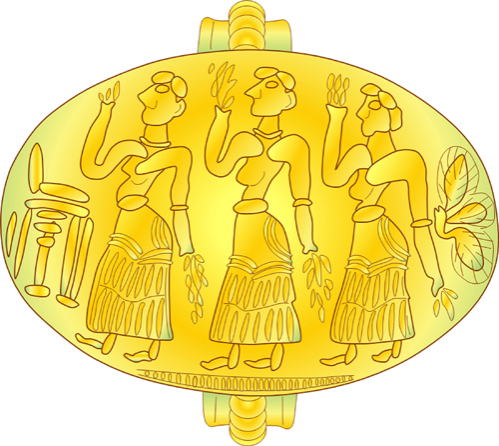 Site: Chamber Tomb 55, Lower Town, Mycenae Shape & Decoration: Gold Signet Ring, arm (hoop)=granulation technique Epiphany: three goddesses or women with flowers, shrine and scared tree Era: LHII-LHIIIA1, 1500-1375 BC Museum: NAM, inv. No. 2853 / L25mm Local: Argolis, Peloponnese Drawing: Eiji OKUBO The gold signet ring shows three goddesses or Mycenaean women carrying flowers in both hands walking along the cobblestone path, presumably to worship at the sanctuary. Two of the women are wearing necklaces and all three are wearing armlets, and they are wearing the characteristic thick skirts influenced by the Minoan civilization of Crete. It is worth noting that when visiting the sacred place, all worshippers, including the goddesses and people of nobility, are barefoot. Also unearthed from the Chamber Tomb 55 was a gold signet ring engraved with a sphinx (NAM inv. No. 1191). III-3-01 Minoan Gold Jewelry “Gold Bee Pendant” 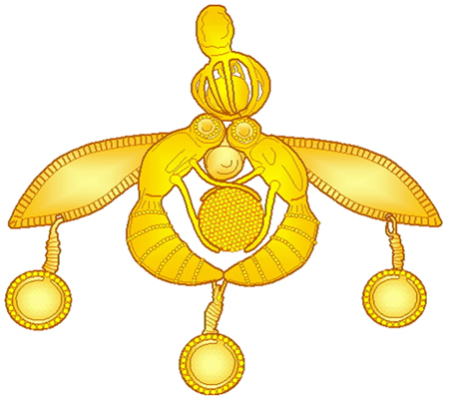 Site: Chrysolakkos Cemetery, Malia Palace Shape & Decoration: Gold Pendant, so-called “Bee Pendant” Gold granulation technique: two bees facing each other Era: MMIIA, 1800-1700 BC Museum: HAM, inv. No. 559 / H46mm Local: Central North, Crete Drawing: Eiji OKUBO The "Gold Bee Pendant," one of the finest gold jewelry pieces from the Minoan civilization, was excavated from the Malia Chrysolakkos Common Cemetery, 35km east of Heraklion, which is the royal burial facility of the Maria Palace and consists of numerous connected buildings, including the colonnaded structure. The gold pendant found in the 1921 excavation was made in the middle of the Old Palace Era, during the MMIIA period of the Middle Minoan civilization, 1800-1700 BC. The gold pendant, which depicts two bees facing each other, is decorated with intricate gold particles and countless beads (small spheres) on the wings, abdomen, around the eyes, and the collected pollen balls. This intricate jewelry technique is called the “Gold Granulation Technique,” which is said to have been developed by the Babylonian Sumerians in the Middle East 5,500 years ago. III-3-06 Mycenaean Ornaments “Gold Diadem” 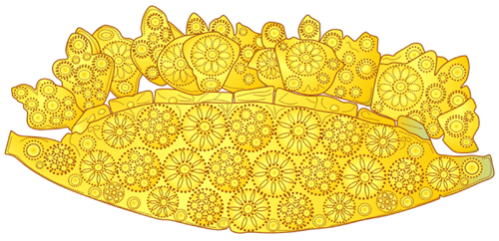 Site: Shaft Grave III, GCA, Mycenae Palace Shape & Decoration: full size Gold luxurious Diadem rosette, circle, stippling patterns in repoussé Era: LHI, 1550-1500 BC Museum: NAM, inv. No. 1 / L635mm Local: Argolis, Peloponnese Drawing: Eiji OKUBO 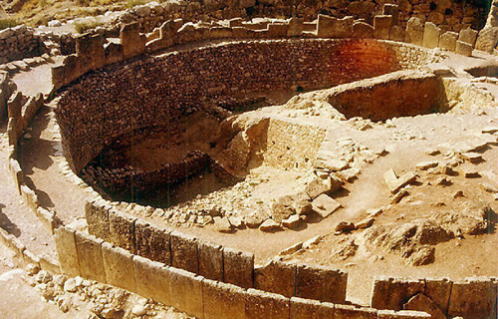 Site: Grave Circle A, Mycenae Palace Situation: A unique Mycenaean cemetery ·double slab circle=outer diameter 27.5m, inner 25m ·center left tomb=largest Shaft Grave IV ·center right tomb=Shaft Grave I Era: MHIII-LHI, 1625-1500 BC Local: Argolis, Peloponnese / 11km north-northeast from Argos city Photo: 1982 GPS: 37°43’49.50’’N 22°45’23’’E / ALT 240m Grave Circle A had a structure in which double circle-shaped stone slabs surrounded the ground surface. The stone slab circle is not a perfect circle, but a slightly distorted, almost circular shape, with the maximum outer diameter of the outer circle being approximately 27.5m, and the inner diameter of the inner circle being about 25m. Construction and burial of Grave Circle A date back to the late 17th century BC, the Middle Helladic MHIII period, around 1600 BC, and subsequent burials continued for about 100 years until the end of the Late Helladic LHI period, around 1500 BC. III-3-13 Mycenaean Gold Necklace “Spiral line” motif 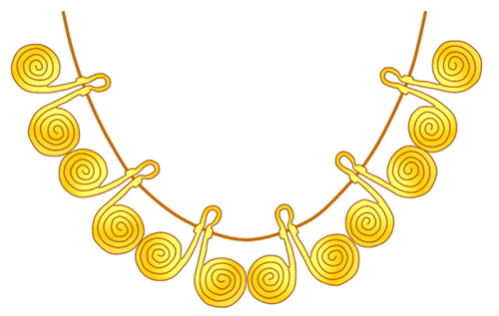 Site: Shaft Grave O, GCB, Mycenae Shape & Decoration: Gold Necklace, twin spiral Era: MHIII, 1625-1500 BC Museum: NAM, inv. No. 8649 Local: Argolis, Peloponnese Drawing: Eiji OKUBO The Shaft Grave O in Grave Circle B of Mycenae contained the burial of multiple women. The simple yet elegant necklace, featuring carefully twisted, symmetrical gold spiral line beads, is so tasteful it would still be considered fashionable today. It was likely worn by high-ranking women, such as royalty associated with the palace, during the Early Mycenaean civilization. III-3-14 Mycenaean Carnelian Beads Necklace 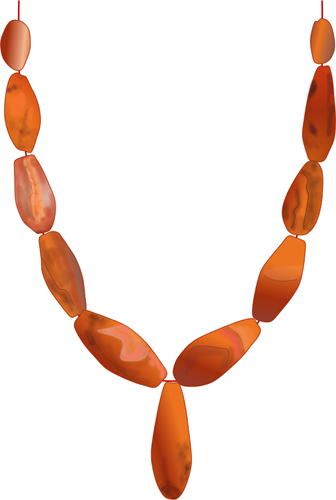 Site: Shaft Grave II, GCA, Mycenae Palace Shape & Decoration: Carnelian beads Necklace Era: MHIII, 1600-1550 BC Museum: NAM, inv. No. 110 and others Local: Argolis, Peloponnese Drawing: Eiji OKUBO III-3-15 Mycenaean Amber Beads Necklace 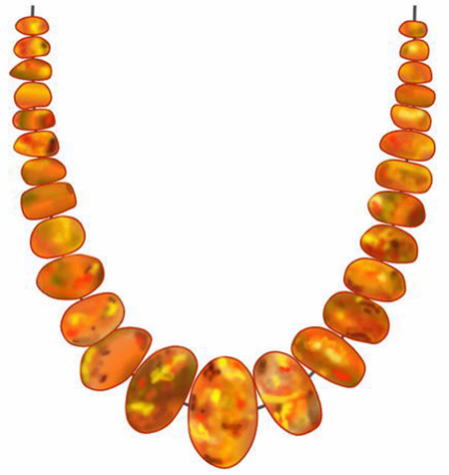 Site: Shaft Grave III, GCA, Mycenae Palace Shape & Decoration: Amber beads Necklace Era: LHI, 1550-1500 BC Museum: NAM Local: Argolis, Peloponnese Drawing: Eiji OKUBO III-3-18 Mycenaean Glass paste Beads Necklace 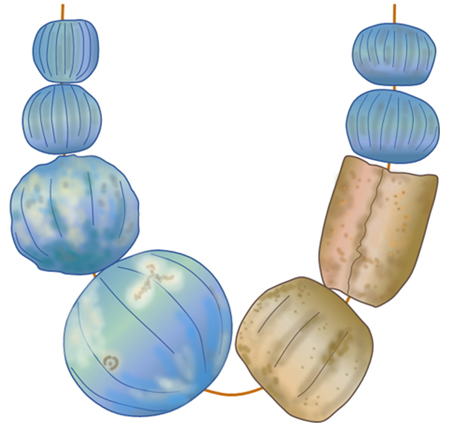 Site: Chamber Tomb 517, Kalkani, Mycenae Shape & Decoration: Glass paste beads Necklace Era: LHII-LHIIIA, 1500-1300 BC Museum: NAM, inv. No. 1724 Local: Argolis, Peloponnese Drawing: Eiji OKUBO III-3-23 Mycenaean Silver Hairpin with gold decoration 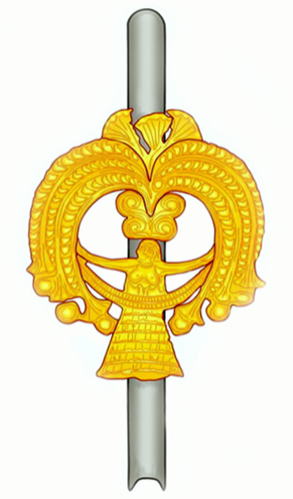 Site: Shaft Grave III, Grave Circle A, Mycenae Palace Shape & Decoration: Silver Hairpin with Gold Pendant ·Minoan Goddess with open arms, palm leaves, papyrus flowers Era: LHI, 1550-1500 BC Museum: NAM, inv. No. 75 / pendant top W67mm, silver pin L215mm Local: Argolis, Peloponnese / 11km north-northeast from Argos city Drawing: Eiji OKUBO GPS: 37°43’49.50’’N 22°45’23’’E / ALT 240m This piece features a pendant imported from the Minoan civilization, attached to a silver hairpin. The pendant itself is made of thin gold sheet with intricately embossed Minoan flower garlands and plant leaves. The goddess, undoubtedly the Minoan goddess, with shoulder-length hair, a high nose, large eyes, and a long dress, is slightly turned to the right, her large bust exposed and arms outstretched. Above the goddess's head are spiral lines, and above her are plant leaves, palm branches, or papyrus garlands that curve dramatically downwards, their ends adorned with fruit-like tassel decorations. III-3-28 Mycenaean Gold Earrings “Sheet & Granulated decoration” 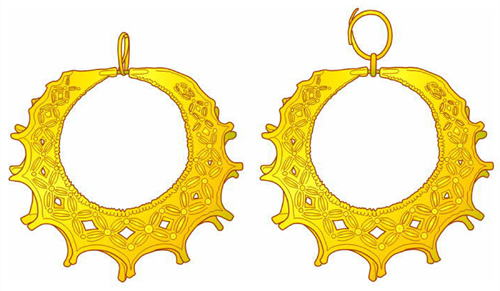 Site: Shaft Grave III, GCA, Mycenae Palace Shape & Decoration: Gold Earrings, chained plant petals, fine granulation technique Era: LHI, 1550-1500 BC Museum: NAM, inv. No. 61 / outer width L76mm Local: Argolis, Peloponnese Drawing: Eiji OKUBO III-3-37 Mycenaean Bronze Mirrors with ivory handle 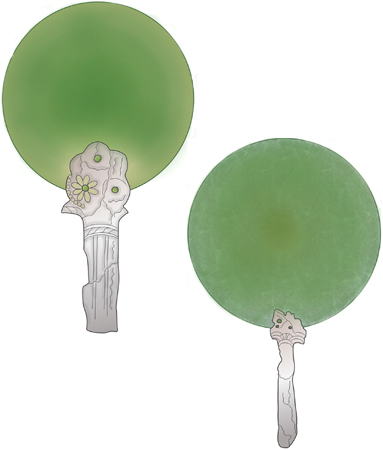 Site: Citadel, Nestor’s Palace Shapee & Decoration: Bronze Mirror with ivory handle Era: LHIIIA, 1400-1300 BC Museum: NAM, inv. No. 8343 / mirror diameter D220mm Local: Messenia, Peloponnese Drawing: Eiji OKUBO Site: Chamber Tomb, Asine Shape & Decoration: Bronze Mirror with ivory handle Era: LHII-LHIIIA, 1500-1300 BC Museum: NFAM Local: Argolis, Peloponnese Drawing: Eiji OKUBO Related: Minoan Queen’s Bathroom with Bathtub 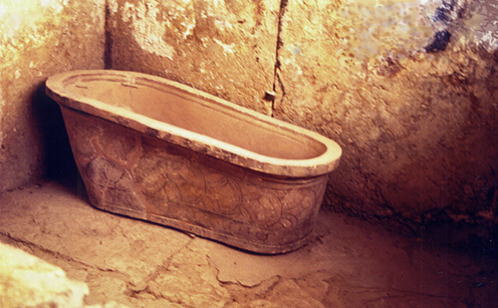 Site: Minoan Queen’s Bathroom, East Wing, Knossos Palace (Currently Restricted Area) Shape & Decoration: Practical bathtub for Minoan Queen so-called “World's oldest bathtub” Era: MMIIIA-LMIIIA1, 1625-1375 BC Exhibit: Palace area Local: Central North, Crete Photo: 1982 In the Queen's Room Complex, the East Wing, Knossos Palace, there is a Minoan Queen's Bathroom directly connected to the west side of the Queen's Room. Unfortunately, it is not currently permitted to enter this bathroom. The Queen's Bathroom is not so large, and inside there is a 1m-high partition wall where small potted plants may have been placed, and on top of that there is a thin column. The practical bathroom space where the Queen's bathtub is located is exactly 2.4m north-south and 2.3m east-west, which is about 3.5 Tatami-mats in Japanese traditional size. Although it is a topic of admiration as the "Minoan Queen's bath," the bathroom is not extremely luxurious at all, and when one actually stands into there, it seems that it was practical to simply use the bathtub to wash one body with hot water. After Evans' excavation mission 125 years ago, the Minoan queen's bathtub, said to be the “World's oldest bathtub," had cracks due to the passage of time and exposure to the dry air of Crete. And at the time of the author's first visit in 1982, the plaster wall of the bathroom covering was peeling off and had discolored and deteriorated considerably. IV-2-02 Minoan Terracotta Rhyton “Goddesses” 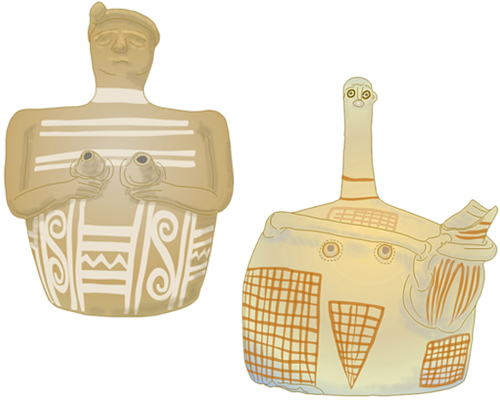 Site: Common cemetery of Mochlos Shape & Decoration: Terracotta Rhyton, “Goddess of Mochlos” Era: EMII, ca. 2400 BC Museum: HAM, inv. No. 5499 / H200mm Local: Eastern North Coast, Crete / 17km east from Agios Nikolaos city Drawing: Eiji OKUBO GPS: 35°11’12’’N 25°54’23’’E / ALT 5m~25m Site: Settlement of Fournou Korifi Shape & Decoration: Terracotta Rhyton vessel, “Goddess of Myrtos” holding a pithos Era: EMIII, ca. 2200 BC Museum: ANAM / H210mm Local: Eastern South Coast, Crete Drawing: Eiji OKUBO IV-2-05 Minoan Faience Rhyton “Snake Goddesses” 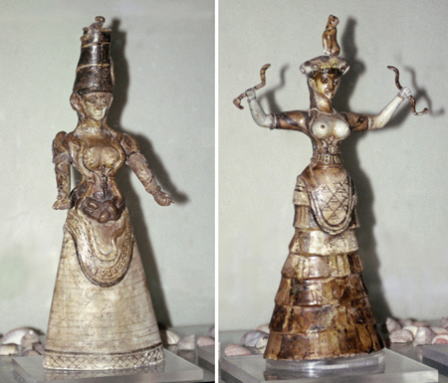 Site: Temple Repositories, Sanctuary, West Wing, Knossos Palace Shape & Decoration: Faience Rhyton, two “Snake Goddesses” Era: MMIIIA, ca. 1625 BC Museum: HAM a) left statue=Mother Goddess, inv. No. 63 / H342mm b) right statue=Daughter Goddess, inv. No. 65 / H295mm Local: Central North, Crete Photo: 1994 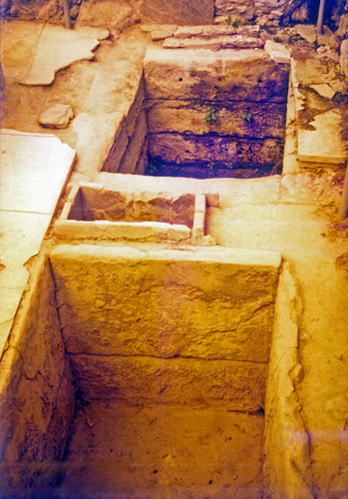 Site: Temple Repositories, Sanctuary Area, West Wing, Knossos Palace (Currently Restricted Area) a) two large and one small underground storage pits for palace treasures b) box-shaped structure made of gypsum slabs Era: MMIIIA-LMIIIA1, 1625-1375 BC Local: Central North, Crete Photo: 1982 In the prehistoric Minoan civilization, the King was worshiped as the God, and the Palace where the king lived had the same meaning as the Temple where the Gods lived, so archaeologists including excavator Sir Arthur John Evans, the Palace Treasury has been called the “Temple Repositories.” In the Sanctuary Area, West Wing of the Knossos Palace, the inner room located to the north of the Waiting Room with stone bench is the Temple Repositories, which is the palace treasure vault. In the Temple Repositories, there are two large, deep square underground storage pits located a little apart each in the east and west. The pit walls are each made of thick gypsum slabs stacked in four tiers, combined with the bottom of the structure paved with gypsum slabs, it has a solid box-like appearance. IV-2-06 Mycenaean Head statue “Sphinx” or “Goddess” 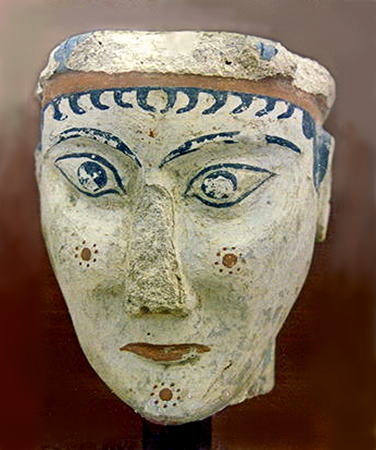 Site: Shrine, Citadel, Mycenae Palace Shape & Decoration: Head Statue of “Sphinx” or “Goddess” a rare example of Mycenaean sculpture in lime-plaster, with a realistic look and painted details Era: LHIIIB1, 1300-1250 BC Museum: NAM, inv. No. 4575 / H168mm Local: Argolis, Peloponnese Photo: 1987 GPS: 37°43’48.50’’N 22°45’24’’E / ALT 240m IV-2-11 Mycenaean Ivory Statue “Female” or “Goddess” 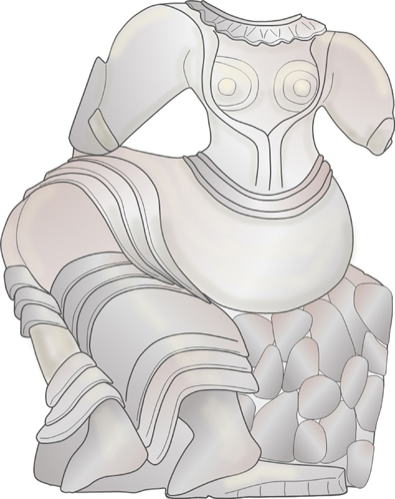 Site: Mansion ruins? Citadel, Mycenae Palace Shape & Decoration: Ivory Statue of Female or Goddess, sitting quietly on a rock Era: LHII-LHIIIA, 1500-1300 BC Museum: NAM, inv. No. 5897 / H85mm Local: Argolis, Peloponnese Drawing: Eiji OKUBO IV-2-13 Mycenaean Terracotta Statues for worship “Goddesses” 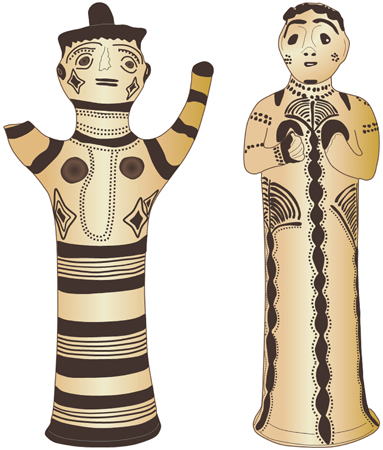 Site: Room of the Fresco, Sanctuary, Mycenae Palace Shape & Decoration: Terracotta Goddess Figurine Era: LHIIIB2, 1250-1200 BC Museum: NFAM, inv. No. 1221 / currently: MYAM, inv. No. 320 Local: Argolis, Peloponnese Drawing: Eiji OKUBO Site: Room of the Idols, Sanctuary, Mycenae Palace Shape & Decoration: Terracotta Goddess Figurine Era: LHIIIB2, 1250-1200 BC Museum: NFAM, inv. No. 1577 currently: MYAM, inv. No. 294 Local: Argolis, Peloponnese / 11km north-northeast from Argos city Drawing: Eiji OKUBO GPS: 37°43’48.50’’N 22°45’24’’E / ALT 240m IV-3-06 Minoan Terracotta Statue “Women dancing” 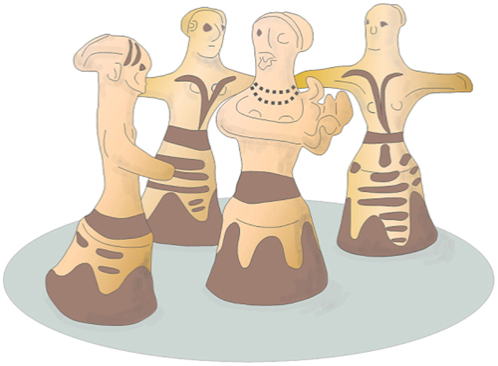 Site: Block Δ, Largest Minoan common’s town, Palaikastro Shape & Decoration: Terracotta statue, “Women dancing,” central woman=lyre performance Era: LMIIIA2, ca. 1350 BC Museum: HAM, inv. No. 3903 Local: Easternmost, Crete Drawing: Eiji OKUBO GPS: 35°11’42’’N 26°16’32’’E / ALT 10m~15m V-3-02 Mycenaean Carnelian Seal “Goddess & Lions” 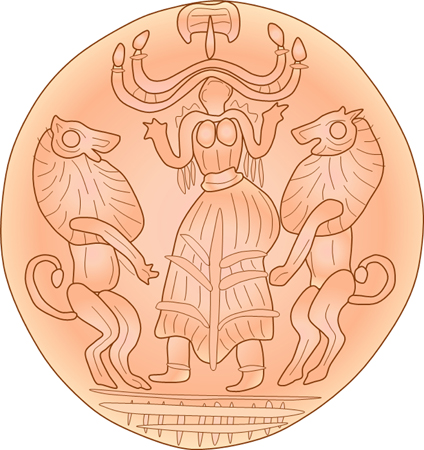 Site: Chamber Tomb 515, Kalkani, Mycenae Shape & Decoration: oval-shaped, Carnelian Seal Epiphany: crowned goddess and two guardian lions Era: LHII-LHIIIA, 1500-1300 BC Museum: NAM, inv. No. 6442ζ / W21.5mm Local: Argolis, Peloponnese Drawing: Eiji OKUBO V-3-03 Mycenaean Agate Seal “Goddess & Griffin” 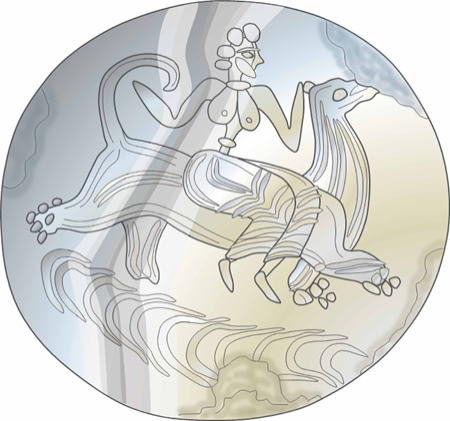 Site: Tholos Tomb of Clytemnestra, Mycenae Shape & Decoration: Agate Seal, goddess riding a griffin Era: LII-LHIIIA, 1500-1300 BC Museum: NAM, inv. No 8718 / L27.5mm Local: Argolis, Peloponnese Drawing: Eiji OKUBO V-3-06 Minoan Clay Imprint “Mother Goddess” 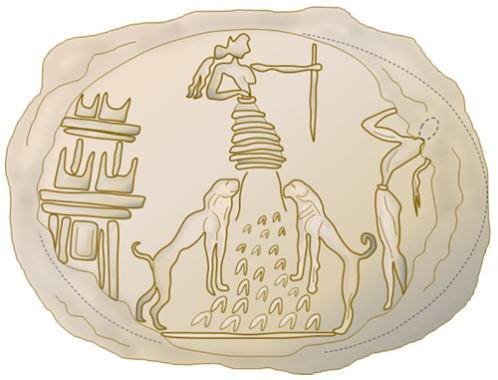 Site: Temple Repositories, West Wing, Knossos Palace Shape & Decoration: Clay Imprint, so-called “Mother Goddess” Motif: sanctuary with bull-horn U-shaped objects, goddess with lions, youth Era: LMIIIA1, ca. 1375 BC Museum: HAM, inv. No. 141-166-168 / L29mm Local: Central North, Crete Drawing: Eiji OKUBO At least eight clay imprints, which named the "Mother Goddess" by researchers for their goddess motif, have been found in the Temple Repositories. Clay seal imprints are made when raw clay on which a stamp is made is burned in an accidental flame, such as a building fire. The clay imprints, the "Mother Goddess," that have been found are in the tattered state each with large and small defects, but the original seal, probably a gold signet ring, on which the imprint was made is oval in shape measuring 29mm long and 19mm wide, and engraved with an Epiphany expression that includes divine elements. V-4-02 Minoan Stone Seals “Noble Women” 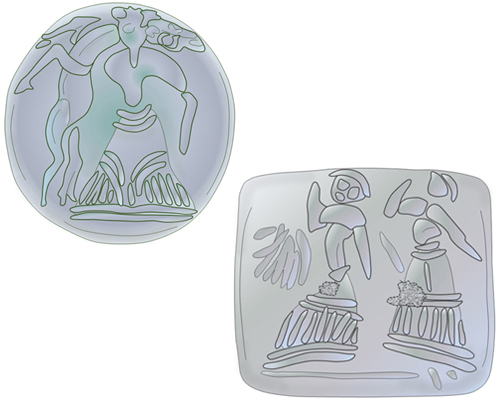 Site: House of the Fresco, Knossos Palace Shape & Decoration: Serpentine Seal, Minoan woman carrying a goat? Era: LMIA-LMIB, 1550-1450 BC Museum: HAM, inv. No. 1287 / W17mm Local: Central North, Crete Drawing: Eiji OKUBO Site: House of the Fresco, Knossos Palace Shape & Decoration: cushion-shaped Steatite Seal, two Minoan women dancing Era: LMIA-LMIB, 1550-1450 BC Museum: HAM, inv. No. 1288 / L16.5mm Local: Central North, Crete Drawing: Eiji OKUBO ----------  |